'The shaft of light! It's beaming onto the idol's hand!
THAT'S where the switch to open the secret door is!'
Type: Strategy / Board/ Resource management (ish)
Players: 1 to 4
Players: 1 to 4
Time to explain to others: About 10 min
Time to play: About 45 minutes
Difficulty: To play 4/10, Game difficulty 6/10
Portability:Low, many tokens and board pieces
Overall: 8/10
Overall: 8/10
Who has never wondered what it would be like, to wonder the jungles of South America, compass on one hand, machete on the other? To wonder into plazas where no man has walked for a millennium? To find the sacred Mayan plinths, dusty brown with the blood of a thousand slaves?
I came across this game as I was looking at the Spiel des Jahres winners (it won in 1999). These are the Oscars of the gaming world, and the winners are always the best of the best (on this blog, Catan and Quirkle come to mind).
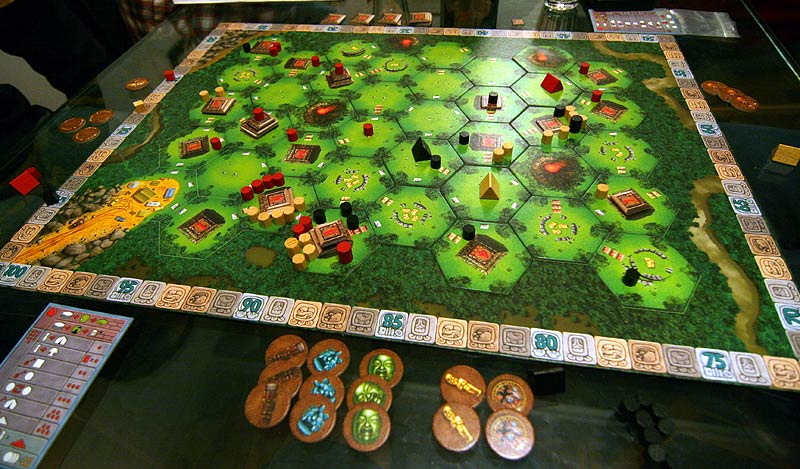
Tikal is a very thematic game, where you play opposing teams of archaeologists, striving to bring out more wonders and plunder out of the Mayan Tikal site (in Guatemala). At the beginning of each turn, each player has 10 action points to use as he/she sees fit. The number of options is fairly extensive, but you can move archaeologists already on site, you can call more onto the site, you can excavate more levels of sunken temples, dig out treasures and many many others.
A couple of innovative mechanics make this a much more strategic game that it might at first look like:
a) the board is built from tiles as you go along (so far, so good), but a number of markers on said tiles will dictate how many action points it takes for characters to move around. It might take 3 points to cross the board, but 8 to get to the one next door, where you actually want to be. (This is explained in game by arguing that there might be say, a hill or a small cliff between certain areas of the board)
b) 2 tiles have a volcano on them, and are therefore named, originally enough, the Volcano Tiles. They have no intrinsic value, they merely signify the start of a scoring round. You only add victory points at these two times. So you might be well behind, but if you throw caution to the wind, and focus on points points points at these times, you might move up quickly.
c) you gain control of a temple by having more people there than your opponent. Due to the capriciousness of movement (see a) ) this is better said than done.
The board is massive and towards the end game it has the tendency to slow down to a crawl. There are some pretty amazing online rules for mini-Tikal, playing on a smaller fraction of the board, and these work beautifully.
This post obviously simplifies the rules and the game. It plays very strategically, almost chess-like at times (not scoring now, but making a new camp, putting me in a much better position over next couple of turns, for example).
Rui's conclusion: Very atmospheric, and strategic. Not very fast, but one to play slowly and think about. Newbies will like it, with guidance. A good after meal game, if you like to fly in and steal the other teams' treasure!
I came across this game as I was looking at the Spiel des Jahres winners (it won in 1999). These are the Oscars of the gaming world, and the winners are always the best of the best (on this blog, Catan and Quirkle come to mind).
Tikal is a very thematic game, where you play opposing teams of archaeologists, striving to bring out more wonders and plunder out of the Mayan Tikal site (in Guatemala). At the beginning of each turn, each player has 10 action points to use as he/she sees fit. The number of options is fairly extensive, but you can move archaeologists already on site, you can call more onto the site, you can excavate more levels of sunken temples, dig out treasures and many many others.
A couple of innovative mechanics make this a much more strategic game that it might at first look like:
a) the board is built from tiles as you go along (so far, so good), but a number of markers on said tiles will dictate how many action points it takes for characters to move around. It might take 3 points to cross the board, but 8 to get to the one next door, where you actually want to be. (This is explained in game by arguing that there might be say, a hill or a small cliff between certain areas of the board)
b) 2 tiles have a volcano on them, and are therefore named, originally enough, the Volcano Tiles. They have no intrinsic value, they merely signify the start of a scoring round. You only add victory points at these two times. So you might be well behind, but if you throw caution to the wind, and focus on points points points at these times, you might move up quickly.
c) you gain control of a temple by having more people there than your opponent. Due to the capriciousness of movement (see a) ) this is better said than done.
The board is massive and towards the end game it has the tendency to slow down to a crawl. There are some pretty amazing online rules for mini-Tikal, playing on a smaller fraction of the board, and these work beautifully.
This post obviously simplifies the rules and the game. It plays very strategically, almost chess-like at times (not scoring now, but making a new camp, putting me in a much better position over next couple of turns, for example).
Rui's conclusion: Very atmospheric, and strategic. Not very fast, but one to play slowly and think about. Newbies will like it, with guidance. A good after meal game, if you like to fly in and steal the other teams' treasure!

