'You don't know where the weapons are stored?...I think you'll find that was a shocking answer....'
Type: Strategy / Card / Deckbuilding
Players: 1 to 4
Players: 1 to 4
Time to explain to others: About 10 min
Time to play: About 90 minutes (mission dependent)
Difficulty: To play 4/10, Game difficulty 8/10
Portability: Medium to high, some cards
Overall: 8/10
Overall: 8/10
Before I even begin this one, I need to admit my bias: I adore the Shadowrun universe. I played the card game, way back in the 90s, and I love every aspect of it.
In a nutshell, in the year 2012 (I know!...), magic returned to the World, in a big way. Some people realised they had magic powers, some mutated into elfs, dwarves, orks and trolls (they had the genes, but the lack of magic in the environment kept it latent).
It is now the 2060s, and we are left, after a lot of political and social upheaval, with the 6th World: A universe where elfs have cybernetic implants, orcs hack into the Matrix (a global 3-dimensional representation of the granddaughter of the internet), and dwarf street samurais kill you as fast as they hit you. In the knees. To start with. Its William Gibson's Neuromancer married with Tolkien. HOW CAN YOU NOT LOVE IT!
Oh and the US president is a dragon. In human form. Did I mention that? I feel like I should.
Crossfire is the latest incarnation of Shadowrun. Like Battletech, this is a franchise full of potential, that somehow successive owners have struggled to pin down.
At its core, it is a deck building game. You have characters (Runners), and each runner has a job (Role). These are interchangeable during set up, although I like my runners to keep their roles (more on this later). Each role has a set of basic cards. As you defeat obstacles you earn money, and buy better/more useful cards. And so you 'enrich' your deck with better cards, as the difficulty increases, levelling up (hopefully!) your abilities as the baddies increase in power and number.
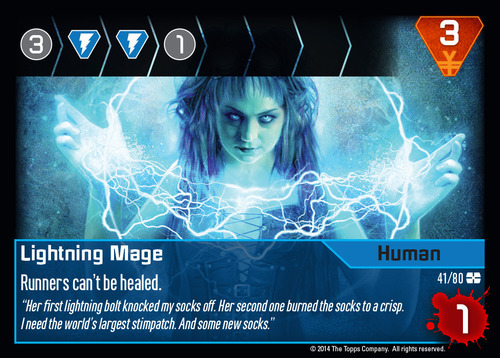
Obstacle cards have power numbers and colours in sequence at the top. Without being fastidious about the rules, all of the runners need to cooperate, to play cards to match numbers (play 3 cards of any colour), or colours (someone on their turn needs to play a blue Mage card). (See above image). When all the icons have been matched, the obstacle is defeated, and the runners score the credits.
It is a hard game, and you die more often than not. When one of your runners dies (it can happen like THAT!), if there is at least 1 other runner alive, it is like the team retreated. If all survive and all obstacles are defeated, it is a win! Experience points are attributed accordingly and may be spent on upgrades.
You are encouraged to play this game as a proper RPG. Upgrades cannot be changed back later on, you are - literally, as you are given stickers - stuck with them. I like to keep my team constant, same runners, same roles.
Rui's conclusion: Hard, strategic (with a touch of combat) and fun. If you're not a fan of the franchise, you will enjoy it, but might miss some nuances. If you want to explore a techno world with cyborgs, dragons, fire spirits and big guns, this is your stop. All change please!

