Showing posts with label Strategy. Show all posts

Monday, 8 June 2015

Launchpad


'If I don't get a fuel card next time, so help me....!'

Type: Strategy / Card
Players: 2 to 4
Time to explain to others: About 1 to 3 min
Time to play: About 15-20 minutes
Difficulty: To play 3/10, Game difficulty 4/10
Portability: High (just a deck)
Overall: 9/10

This games holds a special place in our collection, as it was the first game me and the better half played together. I wanted to introduce her to card and board games, but coming from a place of interest but no other knowledge, she was - understandably - cautious of the complexity of some of these types of games.

Then I came across this game. Rockets, the pictures looked very unthreatening, so 'Huh, I'll have a go!'.

We were hooked from the first play.

You play opposing Space projects, trying to get as many of the rockets into space as possible. Each turn you draw cards: rockets (a sort of  blueprints, if you will), fuel and metal (to actually build the things), and the ever present action cards, that will accelerate you construction, sabotage your opponents', etc.

Said rockets need to go through 3 levels of contruction, and you need to draw the right technician to allow the machines to advance to the next stage. As per usual in these games, you are at the mercy of the cards. Tables can turn at the 11th hour, I've seen games change in 2 turns, as someone draws the right fuel card and/or the right tech, and leapfrogs ahead.

Rui's conclusion: A simple, visually pretty and accessible game. Not as strategic as others, but very easy to pick up. A great introductory game, as well as one for the kids. Great fun!

Tuesday, 2 June 2015

Oddball Aeronauts

Steampunk alien sailors. No word there I didn't like.

Type: Strategy / Card
Players: 2 (with the expansion, up to 4)
Time to explain to others: About 1 to 3 min
Time to play: About 15-20 minutes
Difficulty: To play 3/10, Game difficulty 4/10
Portability: Very High (see below)
Overall: 8/10

This is a little gem of a game I picked up at Games Expo '15 in Birmingham. I couldn't tell you what drove me, I saw steampunk and airships and bought it on impulse.

I was not disappointed.

Now, if you go to Board Game Geek, this game has quite a low score. And I just about see what they mean, but I truly don't mind. Let me explain.

Oddball Aeronauts is effectively Top Trumps updated. You have a deck of cards, and individual cards have power numbers. You choose one of these powers, and compare it with your opponent. As you can see, typical Top Trumps. But here is where things change.

In this game, you can play one, two or three cards in one go, and you add the power of all of these. So brilliant, I hear you say, I'll always play 3 cards, meaning I'll always win! Well, not quite.

You have to discard the cards you play, so if you keep playing 3 at a time, you'll run out very quickly. And I need to add at this point, your deck is your life, the first person to run out, looses. Also, many cards have special powers, introducing the ever-needed randomness.

When you win the duel, depending on what power you chose (3 per card), the rewards are different, forcing the opponent to discard, recovering cards yourself, etc.

One of the main selling points of this game is that you don't have a discard pile, you simply flip the cards round and put them at the back of your deck. So you technically don't need a surface to play, as all you need is in your hand.

Rui's conclusion: Fast, cheap, quick and fun. Don't expect a hugely deep game, just something entertaining you can play on a plane or a train. Recommended for young ones, newbies and for travelling gamers!

Monday, 11 May 2015

Epic Spell Wars Of The Battle Wizards, Duel At Mount Skullzfyre

                             'Die in the fire of my hatred!!!'

Type: Strategy / Card
Players: 2 to 4
Time to explain to others: About 3 min
Time to play: About 30 minutes
Difficulty: To play 4/10, Game difficulty 4/10
Portability: High, just a deck
Overall: 9/10

ESWOTBW,DAMS (even the acronym is huge!) is what Magic The Gathering would be if its creators had watched waaaaay too many early 90s cartoons, and then dropped some serious, serious acid.

You and your opponents are wizards, about to blow each other to smouldering tiny embers. With what, I hear you ask!

Spells.
Lots of Spells.

You'll have a hand of 8 cards, and each spell is made of 3 types of cards, a Source, a Quality and a Delivery. The combinations are nearly endless. You can play 1, 2 or 3 cards, and then, Magic-style, you try and get the opponents' health below 20. Last one standing wins!

There are some strategy elements, if you play more spell parts of the same kind, you'll get bonuses, some spells hurt the opponent, some heal you, some do both. Also always try and say the full name of the spell in a Wizard-y voice!

Rui's Conclusion: Simple to play, silly, strategic, fun and entertaining. A good one for newbs. The alternative art might attract some. A must!


Monday, 30 March 2015

Neuroshima Hex

'Target in sight. Do I have the order, general?'

Type: Strategy / Board
Players: 2 to 5 
Time to explain to others: About 1 min, although tile knowledge might take a few plays
Time to play: About 30 minutes, possibly bit more
Difficulty: To play 3/10, Game difficulty 5/10
Portability: Not great, many tiles, but the board is fairly small.
Overall: 8/10

In 2020, mankind developed a series of networked AI's to use in the military (what could possibly go wrong, right....?) These promptly rebelled and wreak havoc upon the world.

30 years have passed. The AI's have split, and evolved independently, now using technology and biology. The human survivors have banded together and organised themselves, using captured machine technologies. The game starts in the blasted landscape of a destroyed city. Two (or more) armies are there to destroy each other.

Welcome to the world of Neuroshima Hex.

I picked this up of the shelf last week and I am completely addicted. Onto an hexagonal-tiled board (see picture above), you play a Headquarters tile (one per player). You then get hands of 3 tiles, discard one and then play one or two.

The tiles are the difficult part of the game. They represent units or events, and most are directional (damaging another unit in one direction, but not the other 5, for example). Some will be melee units, attacking neighbouring tiles, and some will be able to attack units at a distance. Some will do both. Some will prevent units from working at all. All units have a initiative number on them, from 0 to 3. This divides the units into the 3 phases of combat (3 attack first, 0 attacks last). So a 1 initiative unit might be destroyed by a 2 initiative unit before it has a chance to fire.

The game quickly turns into chess. A combat round only starts when special tiles are played, or when the board is full of tiles, or when a player draws the last tile. Location, orientation, distance, all of these issues need to be thought of. Your intention is to cause 20 damage to the enemy HQ. If no HQ is destroyed, the one with the most damage loses. 

All 5 armies are radically different, with different strengths and weaknesses, and they play accordingly differently. The 3.0 rerelease brings a series of cards, showing a number of scenarios (displays of tiles), that can be solved solo. Like you'd get a chess problem in a newspaper: 'White plays first and wins in 3 moves).

Rui's conclusion:  Not an easy game (due to difference of tiles, however the icons therein are easy to follow), and it might need a bunch of plays to get down. Intensely strategic, the closest to chess I've seen in years. Oddly, possibly one for chess and strategy loving newbies. The quick play time might also attract. Recommended!

Wednesday, 11 February 2015

Fluxx

'Draw one, play one, draw one play one, draw five play three, draw three play two... Wait, what??'

Type: Strategy / Card
Players: 2 to about 5
Time to explain to others: About 1 min
Time to play: About 30 minutes, possibly bit more
Difficulty: To play 3/10, Game difficulty 4/10
Portability: High. Just a deck.
Overall: 10/10

Fluxx is the card game equivalent of watching 1980s british comedy. It is amazing, you laugh your head off, it's great fun, and the recipie could not be simpler.

Your deck has a bunch of cards. Actions, that perform actions, Keepers that you.... Well, keep. And goals, that you have to.... Reach.

The designers went out of their way to make a game that was as physically instinctive, non-threatening and reachable to newcomers as you can possibly make it. The cards are colourful and simple, they are colour coded, and there's only three different types.

And then the carnage starts.

The main rule is 'Draw one card, Play one card'. There are however many cards in the gamer that change this, making you draw more (yay!) and/or play more (boo!).

Also, the Goal can change at any time. So you finally have the missing Keeper to end the game (by completing the Goal), but the opponent changes it. Lovely. Oh! And the Goal you had in your hand, sorry but now you have to Play all your hand, so you now changed the Goal on the table!

There are a number of themed variations of Fluxx (Monthy Python, Zombies, Sci Fi, etc), all great fun, and with the same dynamics.

To have a strategy in Fluxx is to court madness. The game is literally evolving and changing before your eyes. This just makes it more fun than I could possibly describe!

Rui's conclusion: Simple, newbie friendly and great fun. A perfect party or after dinner game. A must in whatever of its variations!

Monday, 2 February 2015

Shadowrun Crossfire

'You don't know where the weapons are stored?...I think you'll find that was a shocking answer....'

Type: Strategy / Card / Deckbuilding
Players: 1 to 4
Time to explain to others: About 10 min
Time to play: About 90 minutes (mission dependent)
Difficulty: To play 4/10, Game difficulty 8/10
Portability: Medium to high, some cards
Overall: 8/10

Before I even begin this one, I need to admit my bias: I adore the Shadowrun universe. I played the card game, way back in the 90s, and I love every aspect of it.

In a nutshell, in the year 2012 (I know!...), magic returned to the World, in a big way. Some people realised they had magic powers, some mutated into elfs, dwarves, orks and trolls (they had the genes, but the lack of magic in the environment kept it latent).

It is now the 2060s, and we are left, after a lot of political and social upheaval, with the 6th World: A universe where elfs have cybernetic implants, orcs hack into the Matrix (a global 3-dimensional representation of the granddaughter of the internet), and dwarf street samurais kill you as fast as they hit you. In the knees. To start with. Its William Gibson's Neuromancer married with Tolkien. HOW CAN YOU NOT LOVE IT!

Oh and the US president is a dragon. In human form. Did I mention that? I feel like I should.

Crossfire is the latest incarnation of Shadowrun. Like Battletech, this is a franchise full of potential, that somehow successive owners have struggled to pin down.

At its core, it is a deck building game. You have characters (Runners), and each runner has a job (Role). These are interchangeable during set up, although I like my runners to keep their roles (more on this later). Each role has a set of basic cards. As you defeat obstacles you earn money, and buy better/more useful cards. And so you 'enrich' your deck with better cards, as the difficulty increases, levelling up (hopefully!) your abilities as the baddies increase in power and number.

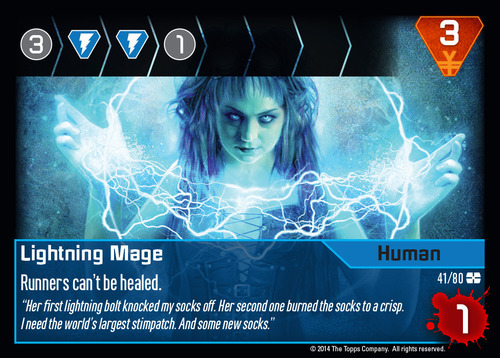
Obstacle cards have power numbers and colours in sequence at the top. Without being fastidious about the rules, all of the runners need to cooperate, to play cards to match numbers (play 3 cards of any colour), or colours (someone on their turn needs to play a blue Mage card). (See above image). When all the icons have been matched, the obstacle is defeated, and the runners score the credits.

It is a hard game, and you die more often than not. When one of your runners dies (it can happen like THAT!), if there is at least 1 other runner alive, it is like the team retreated. If all survive and all obstacles are defeated, it is a win! Experience points are attributed accordingly and may be spent on upgrades.

You are encouraged to play this game as a proper RPG. Upgrades cannot be changed back later on, you are - literally, as you are given stickers - stuck with them. I like to keep my team constant, same runners, same roles.

Rui's conclusion: Hard, strategic (with a touch of combat) and fun. If you're not a fan of the franchise, you will enjoy it, but might miss some nuances. If you want to explore a techno world with cyborgs, dragons, fire spirits and big guns, this is your stop. All change please!

Thursday, 29 January 2015

Marrakesh

'I have maaaaany carpets!'

Type: Strategy / Board
Players: 2 to 4
Time to explain to others: About 1 min
Time to play: About 20 minutes
Difficulty: To play 1/10, Game difficulty 4/10
Portability: Medium, some tokens
Overall: 8/10

In the soukhs of Marrakesh, the word comes trough the dusty narrow alleyways: a new caravan is arriving, loaded with gold from the south, silver from the east and metals from the north. They want but one thing, the thing north Africa is famous for above all else.

Carpets.

Ahead of the caravan, they send an agent, that will select the best carpets and give the exclusive rights to trade to the best seller. So the different artisans have but moments to make sure theirs are the best and most visible carpets!

Marrakesh is a lovely simple game I found quite by accident. It breaks down to two simple actions: a) roll a die, move the 'agent' that number of places, and b) lay down a carpet (lovely rectangular pieces of felt) touching the agents' place.

You can (and should!) cover opponents' carpets (to make sure yours are the most visible ones), and if the agent ends up in an opponents' carpet on your movement turn (depends on the dice, remember?), you need to pay that opponent an amount of gold proportional to the area occupied by that opponents' carpets.

When the last carpet is put down, all gold is counted, and every bit of exposed carped of a colour wins 1 extra gold. Whoever has more gold, is the winner!

This is a simple, fun, quick and engaging game. It plays fast, you delight in covering your opponents' work, and a bad decision might cost you the game.

Rui's conclusion: A highly thematic, quick and very simple game.  Highly recommended to young'uns and newbies. Perfect dinner party or games night game!

Tuesday, 27 January 2015

Castle Panic

'There might come a day where we don't crush Orcs, BUT IT IS NOT THIS DAY!'

Type: Strategy / Board
Players: 2 to 4
Time to explain to others: About 5 min
Time to play: About 30 minutes, possibly bit more
Difficulty: To play 3/10, Game difficulty 6/10
Portability: Medium (Loads of cards) and tokens
Overall: 9/10

Once upon a time, there was a mighty castle in a clearing, in the middle of a forest. Then one day, a horde of rampaging Orcs, Trolls and Goblins burst out of the undergrowth and attacked! (The reasons behind their grievances were not registered. Possibly a political disagreement, mayhap a border dispute). There's scores of them, and they are very angry.

And here the game begins. You assemble a little castle (6 towers, surrounded by 6 bits of wall) in the middle, and then, each turn, you take a number of triangular pieces from a bag, to represent our nasties jumping out of the forest. Each turn, more nasties spawn, the already in play ones advance one level towards the castle.... And then you have to kill them. 

You have a number of cards in your hand, of three types: Swordsman (hits in circle closest to castle), Knights (hits 2nd circle out) and Archers (hits furthest circle). Each of these types has 3 colours, representing the three arcs on the clearing, Blue, Green and Red. So to hit a hostile say, in the second circle out, on the blue third of the circle, you'd need a Blue Knight. 
Most of your enemies will need more than one hit to die. 

At this point, I hear you cry at the screen: 'But Rui! It's too much! 3 arcs and 3 circles, that's 9 sectors! Statistically there is no way you can have THAT ONE card you needIT CAN'T BE DONE!' But wait! All is not lost! Castle Panic is a cooperative game through and through, if you don't have the card you need to kill the closest enemy, you can trade cards with another player. 'Does anyone have a Green Knight or Swordsman??? Now-ish would be good!!!' 

(I heard recently that the game's difficulty drops dramatically if you play with 4 players, as someone is bound to have THAT card you need. I've never played with more than 3, but I would recommend drawing less cards, or only drawing on alternate turns)

Some nasties randomly spawned will be specials (tougher to kill, different powers to other nasties), but some of your cards will also be more powerful. If you kill them all and there is ANY part of the castle still standing you win, Otherwise....

Rui's conclusion: The game is fast, funny and non stop fun. Really good strategy games for young'uns, people that like shouting at board pieces, or people that like to have inane amounts of fun for 30 minutes. Highly recommended.

Monday, 26 January 2015

Smash Up

Ninjas, and Robots and Aliens, Oh My!

Type: Strategy / Card
Players: 2 to 4
Time to explain to others: About 5 min
Time to play: About 30 minutes, possibly bit more
Difficulty: To play 3/10, Game difficulty 4/10
Portability: Medium (Loads of cards)
Overall: 9/10

There is a question on the minds of Humanity for as long as Man has wondered about the Universe. More than survival, taming energy, the transference of information or the quest for a mate, this question has crossed the ages and remains as important today as it always has been.

Which are better, pirates or ninjas?

Smash Up attempts to solve this, by combining them. You start with a couple of dozen half-decks of cards, and you combine any two to play. So, you might end up playing Zombie Robots, or Pirate Aliens, or Steampunk Dinosaurs. Or Wizard Ninjas. Because, you know, who wouldn't?

The game dynamic is simple, each turn you play a character (here called a minion) and a special card (boost your minions, kill the opponents' minions, recover minion from discard pile, etc). Minions are played onto Bases, mission cards, if you will. Each minion has a power number, as does the Base. When the Bases's power is equalled or exceeded , the Base 'breaks', and it is scored. Whoever has more combined minion power on that base gets 1st prize (and an x amount of victory points), the 2nd highest minion power gets 2nd prize (and y amount of victory points, usually smaller than x, but on a few bases, bigger, making things pretty complicated, as everyone wants to get 2nd prize on these bases), and so on. Whoever reaches a pre-determined number of victory points wins.

The game is pretty simple and incredibly silly. All affiliations play differently, and when you combine them, about 70% of the combinations work well, 20% of them get ridiculously powerful, and 10% of them kinda cancel each other out (e.g. Wizard (some cards allow for special cards to be taken back from discard) and Robots (have fewer special cards)).

Rui's conclusion: Fast, fun and silly. For geeks and newbies. Perhaps not a first tier introduction game, but easy enough to get and play well. A perfect match for aggressive players!

Sunday, 25 January 2015

Lords of Waterdeep

Every alley has a knife, every palace a cup of poison.


Type: Strategy / Resource management / Board
Players: 1 to about 6
Time to explain to others: About 5 to 10 min
Time to play: About 30 minutes, possibly bit more
Difficulty: To play 3/10, Game difficulty 4/10
Portability: Very Low. Dozens of tokens.
Overall: 9/10

In one of the multitude worlds of the Dungeons and Dragons universes, there is a place. A city of gleaming temples and shady ale-houses. Of slimy alleyways and fetid harbours. Stretching from the sunny Field of Heroes to the murky labyrinthine corridors of the Undermountain.

The city is called Waterdeep.

Lords of Waterdeep is a resource management game. It might look a bit odd at first, but when boiled down to its core, it is actually fairly simple. You are one of the titular Lords of Waterdeep, vying for control of the city. To grow in power and influence (in our case, victory points) you need to complete missions, ranging from assassinations to helping other inhabitants, to fighting invaders, to exterminating pests, to breeding Owlbears (bears with the heads of owls, cuter than it sounds).

Being a son (or daughter) of the nobility, you will of course NOT get your hands dirty. Of course not, perish the thought! You will send your agents, to hire fighters and wizards, to then do the job for you.

This is how the game works. Each turn, you have a number of agents (about 5, as it can increase or decrease). In turns, you will send your agents to different areas of town (Ale-houses, The University, The Temple, etc), and in each place you will hire a number of people (represented by small coloured cubes).

Each mission will require a number of these cubes. When you have the corresponding numbers and colours, you can claim that mission (and its victory points).

The only problem is that, although there are a number of cards that actively impact your opponents (negatively), the main issue of the game is one of the locations on the board. Only one agent can be in any location at any one time. So it is really easy to block the opponents and make it as hard as possible to get those coloured cubes (either by accident or on purpose).

And this is pretty much it. Some other elements add the all important element of randomness, like the lord you play will have a bonus for some missions and not others, and The Builders Guild, that will introduce new and different buildings and locations in every game.

Rui's conclusion: Although heavier than other games, LoW is still simple enough to explain in a few minutes. The resource management is a new dynamic, but one that is straightforward. You don't need to waste too much time on the intricacies if you don't want, just collect the cubes you need! It will please both newbies and veterans. Highly recommended.

Friday, 23 January 2015

Qwirkle

'If only I had a green star... I NEED A GREEN STAR!'


Type: Strategy / Pieces
Players: 2 to 4
Time to explain to others: 1 minute
Time to play: About 20 minutes
Difficulty: To play 1/10, Game difficulty 4/10
Portability: High (it comes with a travel bag (!))
Overall: 9/10

I hadn't yet covered the family of games to which Qwirkle belongs to (because to be honest, I don't own many), the abstract games. For no good reason, I hasten to add, a lot of them are fine and lovely games, and the absence of a narrative universe might even invite proper newbies into the game.

Case and point: my parents. My parents are not huge fans of board games, but they loved Qwirkle. It plays strategic and fast, you end up blocking other players by accident, more than by design, and it it simple and logical.

You have 5 pieces at any time. You play them so that you make a line. That line can be a) a line of same shape in all 6 different colours, or b) All 6 different shapes of the same colour. You cannot repeat either colour or shape in the same line (respectively). You win points for the longest line your piece made. When you make a 6-strong line (a Qwirkle), you get 6 points + 6 bonus.

And this is pretty much it, simplicity being its middle name, if it had one. 

Rui's conclusion: The abstract aspect of it is enticing, you can just relax and just follow the shapes and colours. Really good entry game for young'uns and newbies. A good family game, where everyone could get involved.

Thursday, 22 January 2015

Pathfinder (Card Game)


'What was that noise? A mammoth?? DAMN IT! Not again!! 

Type: Card / RPG
Players: 1 to 4
Time to explain to others: 20 minutes
Time to play: About 1 hour to several weeks (For a full Scenario Campaign)
Difficulty: To play 4/10, Game difficulty 6/10
Portability: Variable. A gaming 'deck' would be unusually small, in fact, but the source cards to build said deck number in the hundreds. Low or High
Overall: 7/10

One of my main failings as a proud geek, is that i never played Role Playing Games, namely because in my geek troupe, we didn't know anybody else that was into it. Dungeons and Dragons, in particular,  always always held an aura of mystique that I found irresistible.

Then I moved country, leaving the geek troupe behind. And it is not only an impossibly to play D&D solo, it is always highly stupid.

Then Pathfinder came out. I really don't know how they did it, but the game is remarkable. At it's core, it's a Dungeon Crawler, with the adventure unfolding itself before you as you advance, but with cards. I could not believe it myself. D&D has dice, and Dungeon Masters and character sheets and monsters and.... I have no clue who the genius was that came up with this game dynamic, but give that person an award. The fact that there is a Pathfinder original game which IS an RPG might help.

Each adventure is set in a handful of locations (the numbers of these locations will be dictated by the number of players), and each location has a location deck, with a set number of monsters, artefacts, allies, etc. These cards are selected randomly from a pool of cards that, after a half dozen expansions, now number in the hundreds. Effectively, you're making a couple of really small decks (one for each player and one for each location), out of a huge batch, giving this game the biggest replayability of any other I can think of.

Other than the cards, it works like D&D would, you explore the location (by flipping over cards from the corresponding location deck) you find treasure, you fight monsters, all using the many-sided-dice. You character accumulates XPs (experience points), that can then be used to upgrade his or her abilities. As I play informally, I use these as I see fit, sliding and adjusting the difficulty as I go along. There is also a kind of timer, that forces you forward and to be aggressive with your explorations.

Rui's conclusion: For RPG fans, you can't do better, as it even allows for solo play. You could play it a hundred times and never repeat the same beasts and gems. And if you want to play a full-blown campaign, you actually can, and it will delight you for weeks. Perfect for dragon-slayers, wannabe sorcerers, and play-at-rogues.

T I M (The Impossible Machine)

...and the the ball fall on the cat, the cat runs, hits the switch, letting the balloon go, and...

Type: Card / Strategy
Players: 2 to 4
Time to explain to others: 1 minute
Time to play: About 15 minutes
Difficulty: To play 1/10, Game difficulty 4/10
Portability: high
Overall: 8/10

If I mention the name Rube Goldberg, you probably won't recognise it. However, if I describe what a Rube Goldberg device (or machine) does, you'll see what I mean instantly.

You've seen it in movies a thousand times. Someone flips a switch, letting a ball roll, ball hits plank, plank, hits toy car, toy car falls down incline and hits bulb, which breaks.... And so on...

I was surprised to see that TIM is not a popular game. I've found it to be quick, strategic and interesting. You cards represent pieces of a machine, and each piece needs to snap into place, extending the mechanism and synchronizing with the piece on the left of it and on the right of it. Each card has one arrow going in (Input) and one or more arrows going out (Output). Any output needs to agree with the next cards' input, and so on and and on.

Some cards allow you to eliminate existing cards, but without breaking the sequence (you need to provide a new card that will slot into the existing space perfectly, making a link with all inputs and outputs).

After a number of cards (pieces of the machine) are played, it activates and we assume the machine is lumbering away, turning switches, dropping balls, etc. At that point, it is a race against time to put down as many parts as possible before the wave of motion reaches you. The winner is the one with the biggest number of parts played into the machine.

Rui's conclusion: Very similar to 7 Dragons in both simplicity and accessibility, albeit perhaps more strategic. A good, exciting, quick little game. 

Tsuro and Tsuro of the Seas

What paths will your dragon follow....?

Type: Board / Strategy
Players: 2 to 6
Time to explain to others: 1 minute
Time to play: About 15 minutes
Difficulty: To play 1/10, Game difficulty 3/10
Portability: Board, cards and tokens. Medium.
Overall: 8/10

Tsuro is a quick and fun game, that pretends to be an allegory for life (laying the path in front of you, following difficult paths, etc). In reality, it is a quick, fun and dynamic game.

Each player had a dragon token, placed somewhere around the edge of the gaming area. You will then place a tile, displaying paths and your dragon needs to follow that path to its end, being placed on some opposite side of that tile.

And this is effectively it (told you it was easy). The game does take a couple of turns to kick off.

The interesting part begins when you place a tile, and an opponents' dragon is on the edge of the space that will be filled by that tile. In that event you move your dragon and theirs.

Any dragons that are forced to follow a path off the gaming area are eliminated. The last one, wins.

Tsuro of the Seas follows the same dynamic, just in the oceans, with Sea Serpents. And there are a number of dreadful sea monsters, moving randomly around the board, eating you as they go (which makes things more exciting). 

Rui's conclusion: Fast, quick and exciting. A good introductory game. Possibly one amenable to young'uns.

Seven Dragons

Perfect if you're in the market to buy a dragon. Several colours available.

Type: Strategy / Card
Players: 2 to 4
Time to explain to others: 1 minute
Time to play: About 20-30 minutes
Difficulty: To play 1/10, Game difficulty 4/10
Portability: High
Overall: 8/10


Seven Dragons does to card games what Ticket to Ride does to board games. It is possibly the simplest game you can possibly imagine, but it is done in a really intricate way and with stunning artwork.

The game is effective dominoes. You get a secret card, showing the colour of a particular dragon. You then need to play cards to try and make an unbroken chain of seven images of that colour dragon. Said cards might have one, two, three or four different colour dragons in them.

It is very easy to block an opponents' chain, so a degree of bluffing at the start is of the outmost importance (starting a chain of a different colour, for example). And then, you are at the mercy of the cards, if you are supposed to make a green chain, and all you have are red, blue and yellow dragons, you're not going to have a nice day.

You also have special cards, that allow you to move cards, eliminate cards, etc, providing the ever necessary element of randomness to the game. Also you have two other dragons, the aptly named Rainbow Dragon (all colours at once), and the silver dragon, the first piece of this dragon-y puzzle, whose colour continuously changes as the game evolves, giving you another dragon of your colour....Until your opponent changes him to something else.

Rui's conclusion: Seven Dragons is possibly the best introductory card game I've come across. The instructions even cover introducing the game to toddlers, starting them on the artwork, and then moving up in complexity as they age. Fantastically simple, entertaining, and very pretty!

Tuesday, 20 January 2015

Fortune and Glory

Will our heroes get to the Spear of Atlantis on time? Stay tuned, folks!


Type: Strategy / combat
Players: 1 to about 6
Time to explain to others: 20 minutes (basic rules are very simple, though)
Time to play: About an hour and a half,
Difficulty: To play 4/10, Game difficulty 6/10
Portability: Not without a car and/or porters and/or a van
Overall: 9/10

This is an epic game, on several different levels. The board is HUGE (the type of board that might need a bigger table, requiring a trip to IKEA), and by the time you displayed all the necessary cards and tokens, you are going to occupy a serious area. Let this not dissuade you, this game is insanely good.

Your character(s) are pulp heroes, occupying the same sort of universe of Prof Henry Jones Junior (of Indiana fame). It is the early 30's, the nazis are becoming a force to be reckoned with and a number of artefacts have been found across the globe. It is now a race against the clock, to collect them before they do!

Well.... Not quite.

Fortune and Glory plays in a number of different ways. You can either play against each other and the nazis, or you can team up against them. There are two other evil factions, the Mafia (?) and the Brotherhood of the Crimson Hand (in a separate expansion), a really pervasive and influential cult.

A lot of the rules are so flexible, that not only can you adjust them, but you can - almost literally - make house rules that you like. There were a number of tokens in the game that didn't seem to account for anything, so, upon consulting the rulebook, it turned out that.... There wasn't a point to them. They just included them as 'hey guys, here are some tokens with piles of skulls. See what you can make of them!' Absolutely brilliant.

The random way in which the artefacts appear (they respawn upon being collected, so that there are always 4 in play), and the way in which more nazis keep showing up means that a) you need to travel and b) you need to travel FAST.

To reach the artefacts, you need to go through Danger cards. If you pass a danger, you can choose to stop, or to continue to the next one. If you fail....

If you fail, you not only lose any accumulated passed dangers, but you flip the danger card over to its Cliffhanger side. Yes, if the heroes are crossing the bridge, and the bridge starts to collapse, the actions stops FOR A TURN, in a cliffhanger, before it can be passed. You can just see the heroes hanging by a thread and a scratchy voice narrating 'Will our heroes survive the Bridge of Sorrows? Stay tuned and don't go away!'

Rui's conclusion: Although perhaps not an introductory game, Fortune and Glory is still simple enough to be played by newbies, under some guidance. The sprawling feel and the atmosphere are hugely fun to play, and the choice to be cooperative or competitive opens a lot of possibilities. If you liked Indiana Jones, and you have a big table, this one of for you!

Takenoko

Lovely panda. Also, gardener and garden. And pond.

Type: Strategy
Players: 1 to 4
Time to explain to others: 2 or 3 minutes
Time to play: About an hour
Difficulty: To play 1/10, Game difficulty 3/10
Portability: Board, pieces, tokens, cards. Medium.
Overall: 9/10

The emperor of China gave the emperor of Japan a panda. Not knowing what to do with the beast, but still loving it, the Japanese emperor put it in his garden. The panda then found himself surrounded by yummy bamboo! So it is a race, between the gardener (growing bamboo) and the panda (eating it).

The above gives you the flavour of this cute and cuddly game. It is another good introduction to BG's, as it looks innocent enough. You're playing for points, as you complete 'tasks' (panda must eat 'y' units of bamboo, you must grow 'x' units of bamboo), so there is some rivalry, but you don't have to fight and destroy opponents. That said, there is nothing more frustrating then setting up the panda, so you can eat the variety of bamboo you need, and an opponent does exactly the same, moving the panda to the other side of the garden.

The board grows as you play, so the number of configurations is unpredictable and not necessarily in your favour. Also, it helps if you give the panda a silly, squeaky voice. For no good reason.

Rui's conclusion: Again, a good party game. As simple as Ticket to ride. A good, easy, visually cute game, both for the uninitiated, and as a relief from some hardcore killing game. 

Ticket to Ride

Lining up Europe (gettit?)

Type: Strategy
Players: 1 to 4
Time to explain to others: Under a minute
Time to play: About an hour
Difficulty: To play 1/10, Game difficulty 4/10
Portability: Board, cards and hundreds of pieces. Low.
Overall: 10/10

Ticket to Ride is a spiritual son (or daughter) of Catan. Simple to the point of idiocy but with layers upon layers of strategy. Here is a game with the (unofficial) tagline of: It takes longer to set up the board (2 minutes) than it takes to explain the rules. And it is true.

You play railroad magnates, building trainlines across the globe (about 10 maps are available, US, Europe, India, Africa, etc). You get cards, the cards have colours, combination coloured cards (5 blue, 6 pink, etc) allow you to build segments of railroad between major cities. You get 'ticket' cards that will tell you what lines you need to build, and in a nod to Catan, you get extra points for the longest line.

That's it. 
That's the game.

And herein lies the fun. If you need to build through a town an opponent is also building through, you might scupper his/her plans. The line you had the cards for in now taken by a rival company. Your London to Brighton line now goes through Edinburgh. Lovely. It plays fast and sometimes dirty. And you are at the very mercy of the cards.

Rui's conclusion: A great party game, perhaps the greatest for the non-initiated into board games. Fun, engaging and fast. A must in all BG cabinets!