Showing posts with label startegy. Show all posts

Wednesday, 20 May 2015

Machi Koro


'NEED TO BUILD AN ORCHARD!!!'


Type: Strategy / Card
Players: 2 to 4
Time to explain to others: About 1 to 3 min
Time to play: About 30 minutes, possibly bit more
Difficulty: To play 3/10, Game difficulty 4/10
Portability: High to Medium (just a deck, but money tokens)
Overall: 8/10

This game came highly recommended as a simple, easy and accessible game. You are trying to develop the Japanese town of Machi Koro. The inhabitants need 4 landmarks, but these are way to expensive. The only choice is to build an infra structure, so the money rolls in, so that the landmarks can be built!

Each card represents a different building or area (Forests, Stadiums, Farms, etc). They will have a cost (that you need to pay), and a number at the top. You then roll a die(s). Whatever number comes out activates that card, and generates money, gets money from another player, etc. Whoever buils the 4 landmarks fastest wins!

Rui's conclusion: A fantastically easy game, perfect for newbies. Non-threatening, instinctive and fun. Very colourful and engaging, kids will love it. Recommended!

Monday, 27 April 2015

Guillotine


'OFF WITH THEIR HEADS!!'

Type: Strategy / Card
Players: 2 to 4 
Time to explain to others: About 1 min
Time to play: About 30 minutes
Difficulty: To play 2/10, Game difficulty 4/10
Portability: Two small decks, high
Overall: 9/10

Guillotine is a fast and very entertaining game, where you simulate the Reign of Terror of the French Revolution. There are many many necks to be chopped and only 3 days to do it!

At the start of the game, 12 random nobles line up in front of  Mme. Gillotine. The first noble in line will REALLY not have a good time.... But wait! All players have actions cards, that can make the nobles in line move backwards, forwards, randomly, etc.

Sequence of play could not be simpler: play an action card (reordering the line), collect the first noble in line, draw new action card, and the turn is passed. After the 12th noble loses his/her head, the day ends, and 12 more nobles are lined up. Each noble has a number of victory points, and at the end of the 3rd day, whomever has more points wins!

Rui's conclusion: A fast and easy game, perfect for young'uns and newbies. Strategic, but not overwhelmingly so, and very quick. Highly recommended!

Monday, 16 March 2015

Zombie Dice

'Braaaaaaaaaaaaaainssssssss.......'

Type: Strategy / Dice
Players: 2 to whatever (Elimination based)
Time to explain to others: About 1 min
Time to play: About 15 minutes, possibly bit more
Difficulty: To play 1/10, Game difficulty 3/10
Portability: High. Just a set of dice.
Overall: 10/10

You are a hungry zombie, in what looks like is a fairly busy part of the world. Some of your victims are, well.... victims, but others have fairly big shotguns. It is up to you to decide how many victims to attack, but watch out! The first zombie to get to 13 brains wins!

This game is as fun as it is simple. To dictate what your zombie does, and out of 13 dice, you randomly select 3 and roll them. You can get one of three outcomes, a blast (you were shotgunned), some footprints (the victim escaped) and a brain (Mmmmmm.... braaaainsss......). You hold on to shots and brains and reroll the feet, adding new dice if you need to always roll 3.

If you get to 13 brains you win! However, if you collect 3 shots in a turn, you're knocked out, losing all brains you collected on that turn.The game quickly becomes a race against time, with zombies pulling back, when they accumulate 2 shots (they reset at the end of turn), and pushing forward again and again, trying for those yummy brains.

Rui's Conclusion: Fast, entertaining and endlessly fun. A good warm up game, fun for all ages and abilities. A must-have! 

Friday, 6 February 2015

Tikal

'The shaft of light! It's beaming onto the idol's hand! 
THAT'S where the switch to open the secret door is!'

Type: Strategy / Board/ Resource management (ish)
Players: 1 to 4
Time to explain to others: About 10 min
Time to play: About 45 minutes
Difficulty: To play 4/10, Game difficulty 6/10
Portability:Low, many tokens and board pieces
Overall: 8/10

Who has never wondered what it would be like, to wonder the jungles of South America, compass on one hand, machete on the other? To wonder into plazas where no man has walked for a millennium? To find the sacred Mayan plinths, dusty brown with the blood of a thousand slaves?

I came across this game as I was looking at the Spiel des Jahres winners (it won in 1999). These are the Oscars of the gaming world, and the winners are always the best of the best (on this blog, Catan and Quirkle come to mind).

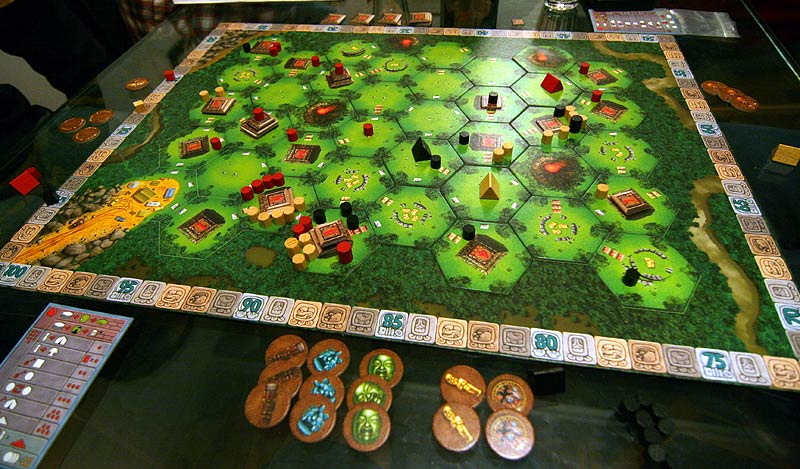
Tikal is a very thematic game, where you play opposing teams of archaeologists, striving to bring out more wonders and plunder out of the Mayan Tikal site (in Guatemala). At the beginning of each turn, each player has 10 action points to use as he/she sees fit. The number of options is fairly extensive, but you can move archaeologists already on site, you can call more onto the site, you can excavate more levels of sunken temples, dig out treasures and many many others.

A couple of innovative mechanics make this a much more strategic game that it might at first look like:

a) the board is built from tiles as you go along (so far, so good), but a number of markers on said tiles will dictate how many action points it takes for characters to move around. It might take 3 points to cross the board, but 8 to get to the one next door, where you actually want to be. (This is explained in game by arguing that there might be say, a hill or a small cliff between certain areas of the board)

b) 2 tiles have a volcano on them, and are therefore named, originally enough, the Volcano Tiles. They have no intrinsic value, they merely signify the start of a scoring round. You only add victory points at these two times. So you might be well behind, but if you throw caution to the wind, and focus on points points points at these times, you might move up quickly.

c) you gain control of a temple by having more people there than your opponent. Due to the capriciousness of movement (see a) ) this is better said than done.

The board is massive and towards the end game it has the tendency to slow down to a crawl. There are some pretty amazing online rules for mini-Tikal, playing on a smaller fraction of the board, and these work beautifully.

This post obviously simplifies the rules and the game. It plays very strategically, almost chess-like at times (not scoring now, but making a new camp, putting me in a much better position over next couple of turns, for example).

Rui's conclusion: Very atmospheric, and strategic. Not very fast, but one to play slowly and think about. Newbies will like it, with guidance. A good after meal game, if you like to fly in and steal the other teams' treasure!

Friday, 23 January 2015

Arkham Horror

Who knows what evil lurks in Arkham....? The Investigators know!....

Type: Strategy / Board
Players: 1 to about 6
Time to explain to others: About 20 to 30 min
Time to play: A minimum of a few hours. Depending of number of players, 5 isn't unreasonable
Difficulty: To play 6/10, Game difficulty 9/10
Portability: Non-existent. Hundreds of tokens.
Overall: 9/10

Arkham Horror is a name spoken in whispers wherever two or more geeks meet. It is a name spoken in hushed tones, as you hear described how long it took to play, how many were killed by monsters.... And how amazingly fun it was.

The game is set in the Lovecraftian universe, in the titular town of Arkham, Massachusetts. Once again, it looks like the stars are right, for the Great Old Ones are restless in their sleep....

And are about to wake.

And they're hungry.

As the action progresses, portals start to open all over town. From these portals, nameless obscenities are crawling forth, heralding the coming of the End.

The players will have to move one or more characters around the board (both in Arkham and in other dimensions), fighting monsters, closing portals and trying their best not to die. Horribly. In pain. Pretty much forever.

To try and describe the intricacy of this game would be a disservice to it. There are layers upon layers and circles within circles of complexity, that just add atmosphere and depth to the game.

The fact that, like most Lovecraftian games, you feel like you're playing against unwinnable odds, has a tendency to unite players. That's another thing, you HAVE to play cooperatively. Even then it will be damn hard. There are a number of expansions, that introduce a number of SECOND town boards (more fictitious town in the area, like Innsmouth), taking the dial all the way to 11.

Rui's conclusion: Not for the faint hearted, it will last a bunch of hours. Oh you have hours? And a half dozen geek friends? And you're in the mood to go tentacle-busting? Then stop whatever you're doing and play this. Highly recommended.

Wednesday, 21 January 2015

Magic, the Gathering

What colour will YOU be?

Type: Strategy / Card
Players: 2
Time to explain to others: 5 to 10 minutes
Time to play: About 20-30 minutes
Difficulty: To play 4/10, Game difficulty 5/10
Portability: High
Overall: 10/10

As hinted at on my last post, here we go.

*deep breath*

Amongst the multitude dimensions, there is a place. In the centre of a storm-battered plain, rolling purple-grey clouds above, there is a huge, dark, dusty temple dedicated to all card games that didn't work. There are dozens, perhaps hundreds of niches, each one with the skeletal mummies of games past. A place filled with brilliant but over complicated, or too simple, or badly drawn card games. Or good ones that simply could not reach up to the Leviathan.

I'm talking about Magic The Gathering.

Starting in the mid 90's, this game has managed to live, expand, evolve, and leave all others behind it. And it did all of this in just one way: Simplicity

The first time you pick up a Magic deck, you might feel a bit daunted, but don't! Starter decks are still published CONTINUOUSLY (like they have over the last 20 years). And inside most of them, there are simple rules for you to start playing. (that failing, their website has the same quick intro)

You and your opponent are wizards, fighting each other. Your decks have 3 types of cards, Creatures, Lands and Spells. Creatures fight other creatures (or failing that, the opposing wizard), lands give the resources to 'build' creatures or spells, and spells give the game a measure of unpredictability, boosting or killing creatures, injuring the wizard, defending creatures, etc.

Each card has a text box, filled with instructions. Some of the keywords might take a couple of games to get used to, but even the rookiest of players can start being decent at magic in a couple of games. And seeing your opponent play a card you've never seen, is an excuse to engage in conversation: 'What card is that? What does it do? Can I have a closer look?'

There are 5 factions in Magic (green, white, red, blue and black), each with radically different playing techniques. Finding the one you like is half the fun. And most decks have more than one colour (for balance and optimization), which then create issues with the type and number of lands....

Reams of paper and Terabytes of information are available out there on Magic tactics and deckbuilding. Some might complain about Magic's incessant expansion and how you continuously need to buy new decks and new boosters. All I will say is this: as I only play Magic informally, my investment to date has been modest. 

Rui's conclusion: The game is wonderful, flows fast and is really exciting. If you have 30 minutes to spare, you can do no worse.

Tuesday, 20 January 2015

Boss Monster


Type: Strategy / Card
Players: 2
Time to explain to others: 2 minutes 
Time to play: About 20 minutes
Difficulty: To play 2/10, Game difficulty 5/10
Portability: High
Overall: 9/10

Boss Monster is the first card game I'm covering, as I draw a deep long breath before I cover the Leviathan that is the card game to end all card games, I mean of course....

But I digress, that is talk for another time.

Boss Monster is a fun and fast cardgame, originally funded by Kickstarter, the haven of everything that is kitch, retro and 80's. Instead of being a hero fighting its way into a dungeon, you are the boss monster at the end, building you neat little dungeon, to try and obliterate any incoming heroes.

Keeping with the 80s look, the cards are pixelated, and the dungeon works linearly, from left to right, like on a 2D scrolling arcade or early ZX Spectrum or really early PC game. There are a handful of rules, that can be explained in a few minutes, and then its Hi-oh, hi-oh, to build our dungeon we go.

Rui's conclusion: Fast, easy and visually compelling. The retro look will attract the 1980-early 90s generation, as well as the more curious kids. Ultimately, really entertaining!