Showing posts with label board. Show all posts

Thursday, 9 July 2015

Dungeon Quest

'What was that noise......aaaaaand I'm dead'.

Type: Strategy / Board / Dungeon Crawl
Players: 1 to 4
Time to explain to others: About 1 to 3 min
Time to play: About 15-20 minutes
Difficulty: To play 3/10, Game difficulty 9/10
Portability: Low (Loads of tokens and board tiles)
Overall: 9/10

What a game this is, readers. If Pathfinder is a perfect card version of D&D (as it is effectively a V3.75, long story), this is its board game soul brother. You start with an adventurer and you advance into a cursed dungeon . You are on a timer, as the dungeon seals itself at sunset. You need to go in, revealing tiles as you go, all the way to the dragon hoard in the middle, steal some of it and make your way back.

Also you will die.

Loads.

Someone with better maths skills than mine has crunched the numbers. The probability of someone making it all the way back without dying is....

16%

That's it.

It is an unforgiving game. Some traps just flat out kill you about 2 out of 3 times. Many animals just pop out and give you about 70 percent damage in one go. Also the dragon in the middle is usually asleep.

Usually.

I have never seen the like. It is, however, amazingly fun. You do feel it in your core that the next revealed tile might (and probably will) be your last.

Rui's conclusion: A fast paced and unforgiving game. With a couple of adaptations (e.g. respawn) this might be a really great game for the uninitiated. Take 20 minutes and try and beat the dragon!

Monday, 30 March 2015

Neuroshima Hex

'Target in sight. Do I have the order, general?'

Type: Strategy / Board
Players: 2 to 5 
Time to explain to others: About 1 min, although tile knowledge might take a few plays
Time to play: About 30 minutes, possibly bit more
Difficulty: To play 3/10, Game difficulty 5/10
Portability: Not great, many tiles, but the board is fairly small.
Overall: 8/10

In 2020, mankind developed a series of networked AI's to use in the military (what could possibly go wrong, right....?) These promptly rebelled and wreak havoc upon the world.

30 years have passed. The AI's have split, and evolved independently, now using technology and biology. The human survivors have banded together and organised themselves, using captured machine technologies. The game starts in the blasted landscape of a destroyed city. Two (or more) armies are there to destroy each other.

Welcome to the world of Neuroshima Hex.

I picked this up of the shelf last week and I am completely addicted. Onto an hexagonal-tiled board (see picture above), you play a Headquarters tile (one per player). You then get hands of 3 tiles, discard one and then play one or two.

The tiles are the difficult part of the game. They represent units or events, and most are directional (damaging another unit in one direction, but not the other 5, for example). Some will be melee units, attacking neighbouring tiles, and some will be able to attack units at a distance. Some will do both. Some will prevent units from working at all. All units have a initiative number on them, from 0 to 3. This divides the units into the 3 phases of combat (3 attack first, 0 attacks last). So a 1 initiative unit might be destroyed by a 2 initiative unit before it has a chance to fire.

The game quickly turns into chess. A combat round only starts when special tiles are played, or when the board is full of tiles, or when a player draws the last tile. Location, orientation, distance, all of these issues need to be thought of. Your intention is to cause 20 damage to the enemy HQ. If no HQ is destroyed, the one with the most damage loses. 

All 5 armies are radically different, with different strengths and weaknesses, and they play accordingly differently. The 3.0 rerelease brings a series of cards, showing a number of scenarios (displays of tiles), that can be solved solo. Like you'd get a chess problem in a newspaper: 'White plays first and wins in 3 moves).

Rui's conclusion:  Not an easy game (due to difference of tiles, however the icons therein are easy to follow), and it might need a bunch of plays to get down. Intensely strategic, the closest to chess I've seen in years. Oddly, possibly one for chess and strategy loving newbies. The quick play time might also attract. Recommended!

Sunday, 8 February 2015

Carcassonne


'Where the hells is this road going to go....?'
Type: Strategy / Board
Players: 2 to about 5
Time to explain to others: About 1 to 3 min
Time to play: About 30 minutes, possibly bit more
Difficulty: To play 3/10, Game difficulty 4/10
Portability: Medium. Loads of board tiles
Overall: 9/10

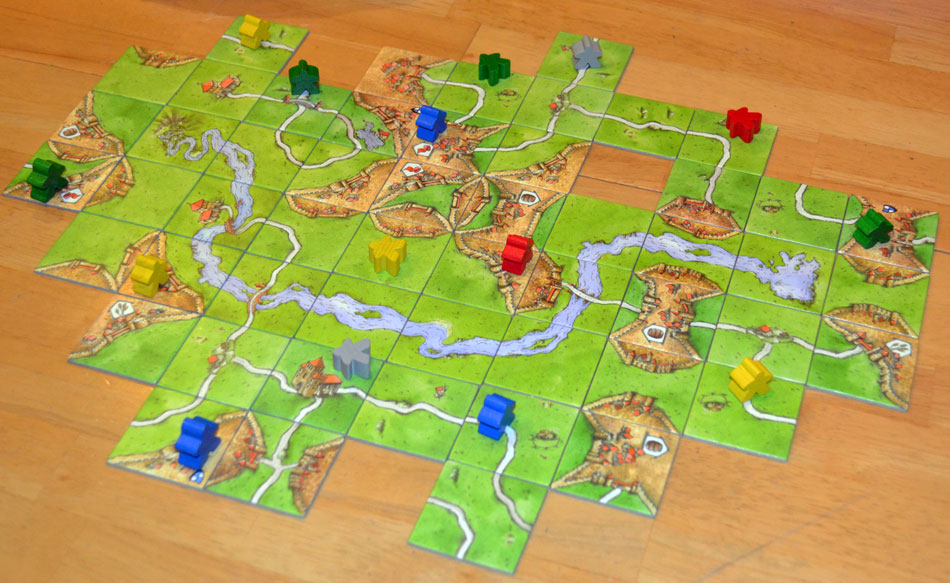
Carcassonne slipped through my fingers like sand through the hands of a toddler. I had totally forgotten about this lovely and simple Eurogame (Eurogames or German Games are games that focus more on strategy and resource management to get victory points, and not Player v Player conflict). A soul brother to Catan, although even simpler (if that is possible).

In each turn in Carcassonne, you play a tile, and have the possibility to play a person marker (the ever iconic Meeple). Depending on where you play the Meeple, it might become a farmer (in a field), a highwayman (in a road), a knight (in a city), a monk (in a monastery), etc. The game comes into its own because every played tile needs to connect fully with a previous one (roads can't start and end in the ether, cities must be closed by walls, etc).

You only have half a dozen meeples and although you can claim them back once you score an area (city, road.... you get the idea), you are at the mercy of the tiles. If you need to finish a city with a city tile, with a diagonal city wall running from upper left to lower right.... You might be in a lot of trouble, as your meeple knight is now stuck there, in a place where it will still score some point at game's end, but a fraction of what it would if you actually finished the city. There are by now about a dozen expansions with new tiles and new types of meeples, that keep adding to the story. You can still have a lot of fun with the base box though!

Rui's conclusion: Fast, engaging, simple and fun. A good warm-up game, or one for newbies. A hit, and rightly so!

Friday, 6 February 2015

Tikal

'The shaft of light! It's beaming onto the idol's hand! 
THAT'S where the switch to open the secret door is!'

Type: Strategy / Board/ Resource management (ish)
Players: 1 to 4
Time to explain to others: About 10 min
Time to play: About 45 minutes
Difficulty: To play 4/10, Game difficulty 6/10
Portability:Low, many tokens and board pieces
Overall: 8/10

Who has never wondered what it would be like, to wonder the jungles of South America, compass on one hand, machete on the other? To wonder into plazas where no man has walked for a millennium? To find the sacred Mayan plinths, dusty brown with the blood of a thousand slaves?

I came across this game as I was looking at the Spiel des Jahres winners (it won in 1999). These are the Oscars of the gaming world, and the winners are always the best of the best (on this blog, Catan and Quirkle come to mind).

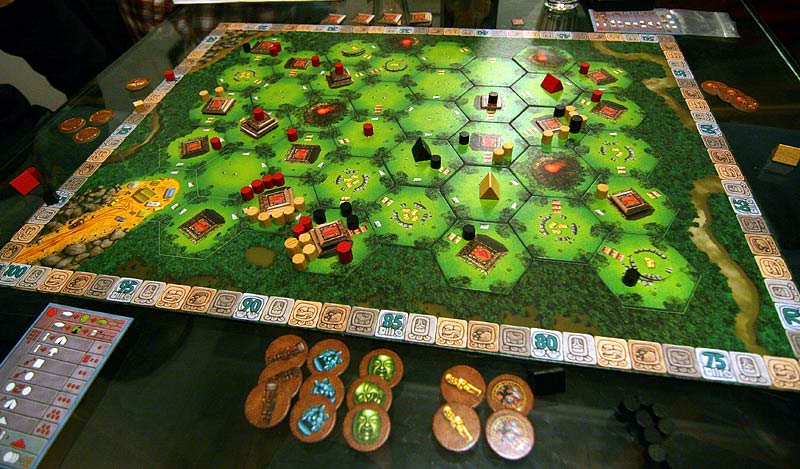
Tikal is a very thematic game, where you play opposing teams of archaeologists, striving to bring out more wonders and plunder out of the Mayan Tikal site (in Guatemala). At the beginning of each turn, each player has 10 action points to use as he/she sees fit. The number of options is fairly extensive, but you can move archaeologists already on site, you can call more onto the site, you can excavate more levels of sunken temples, dig out treasures and many many others.

A couple of innovative mechanics make this a much more strategic game that it might at first look like:

a) the board is built from tiles as you go along (so far, so good), but a number of markers on said tiles will dictate how many action points it takes for characters to move around. It might take 3 points to cross the board, but 8 to get to the one next door, where you actually want to be. (This is explained in game by arguing that there might be say, a hill or a small cliff between certain areas of the board)

b) 2 tiles have a volcano on them, and are therefore named, originally enough, the Volcano Tiles. They have no intrinsic value, they merely signify the start of a scoring round. You only add victory points at these two times. So you might be well behind, but if you throw caution to the wind, and focus on points points points at these times, you might move up quickly.

c) you gain control of a temple by having more people there than your opponent. Due to the capriciousness of movement (see a) ) this is better said than done.

The board is massive and towards the end game it has the tendency to slow down to a crawl. There are some pretty amazing online rules for mini-Tikal, playing on a smaller fraction of the board, and these work beautifully.

This post obviously simplifies the rules and the game. It plays very strategically, almost chess-like at times (not scoring now, but making a new camp, putting me in a much better position over next couple of turns, for example).

Rui's conclusion: Very atmospheric, and strategic. Not very fast, but one to play slowly and think about. Newbies will like it, with guidance. A good after meal game, if you like to fly in and steal the other teams' treasure!

Thursday, 29 January 2015

Marrakesh

'I have maaaaany carpets!'

Type: Strategy / Board
Players: 2 to 4
Time to explain to others: About 1 min
Time to play: About 20 minutes
Difficulty: To play 1/10, Game difficulty 4/10
Portability: Medium, some tokens
Overall: 8/10

In the soukhs of Marrakesh, the word comes trough the dusty narrow alleyways: a new caravan is arriving, loaded with gold from the south, silver from the east and metals from the north. They want but one thing, the thing north Africa is famous for above all else.

Carpets.

Ahead of the caravan, they send an agent, that will select the best carpets and give the exclusive rights to trade to the best seller. So the different artisans have but moments to make sure theirs are the best and most visible carpets!

Marrakesh is a lovely simple game I found quite by accident. It breaks down to two simple actions: a) roll a die, move the 'agent' that number of places, and b) lay down a carpet (lovely rectangular pieces of felt) touching the agents' place.

You can (and should!) cover opponents' carpets (to make sure yours are the most visible ones), and if the agent ends up in an opponents' carpet on your movement turn (depends on the dice, remember?), you need to pay that opponent an amount of gold proportional to the area occupied by that opponents' carpets.

When the last carpet is put down, all gold is counted, and every bit of exposed carped of a colour wins 1 extra gold. Whoever has more gold, is the winner!

This is a simple, fun, quick and engaging game. It plays fast, you delight in covering your opponents' work, and a bad decision might cost you the game.

Rui's conclusion: A highly thematic, quick and very simple game.  Highly recommended to young'uns and newbies. Perfect dinner party or games night game!

Tuesday, 27 January 2015

Castle Panic

'There might come a day where we don't crush Orcs, BUT IT IS NOT THIS DAY!'

Type: Strategy / Board
Players: 2 to 4
Time to explain to others: About 5 min
Time to play: About 30 minutes, possibly bit more
Difficulty: To play 3/10, Game difficulty 6/10
Portability: Medium (Loads of cards) and tokens
Overall: 9/10

Once upon a time, there was a mighty castle in a clearing, in the middle of a forest. Then one day, a horde of rampaging Orcs, Trolls and Goblins burst out of the undergrowth and attacked! (The reasons behind their grievances were not registered. Possibly a political disagreement, mayhap a border dispute). There's scores of them, and they are very angry.

And here the game begins. You assemble a little castle (6 towers, surrounded by 6 bits of wall) in the middle, and then, each turn, you take a number of triangular pieces from a bag, to represent our nasties jumping out of the forest. Each turn, more nasties spawn, the already in play ones advance one level towards the castle.... And then you have to kill them. 

You have a number of cards in your hand, of three types: Swordsman (hits in circle closest to castle), Knights (hits 2nd circle out) and Archers (hits furthest circle). Each of these types has 3 colours, representing the three arcs on the clearing, Blue, Green and Red. So to hit a hostile say, in the second circle out, on the blue third of the circle, you'd need a Blue Knight. 
Most of your enemies will need more than one hit to die. 

At this point, I hear you cry at the screen: 'But Rui! It's too much! 3 arcs and 3 circles, that's 9 sectors! Statistically there is no way you can have THAT ONE card you need! IT CAN'T BE DONE!' But wait! All is not lost! Castle Panic is a cooperative game through and through, if you don't have the card you need to kill the closest enemy, you can trade cards with another player. 'Does anyone have a Green Knight or Swordsman??? Now-ish would be good!!!' 

(I heard recently that the game's difficulty drops dramatically if you play with 4 players, as someone is bound to have THAT card you need. I've never played with more than 3, but I would recommend drawing less cards, or only drawing on alternate turns)

Some nasties randomly spawned will be specials (tougher to kill, different powers to other nasties), but some of your cards will also be more powerful. If you kill them all and there is ANY part of the castle still standing you win, Otherwise....

Rui's conclusion: The game is fast, funny and non stop fun. Really good strategy games for young'uns, people that like shouting at board pieces, or people that like to have inane amounts of fun for 30 minutes. Highly recommended.

Sunday, 25 January 2015

Lords of Waterdeep

Every alley has a knife, every palace a cup of poison.


Type: Strategy / Resource management / Board
Players: 1 to about 6
Time to explain to others: About 5 to 10 min
Time to play: About 30 minutes, possibly bit more
Difficulty: To play 3/10, Game difficulty 4/10
Portability: Very Low. Dozens of tokens.
Overall: 9/10

In one of the multitude worlds of the Dungeons and Dragons universes, there is a place. A city of gleaming temples and shady ale-houses. Of slimy alleyways and fetid harbours. Stretching from the sunny Field of Heroes to the murky labyrinthine corridors of the Undermountain.

The city is called Waterdeep.

Lords of Waterdeep is a resource management game. It might look a bit odd at first, but when boiled down to its core, it is actually fairly simple. You are one of the titular Lords of Waterdeep, vying for control of the city. To grow in power and influence (in our case, victory points) you need to complete missions, ranging from assassinations to helping other inhabitants, to fighting invaders, to exterminating pests, to breeding Owlbears (bears with the heads of owls, cuter than it sounds).

Being a son (or daughter) of the nobility, you will of course NOT get your hands dirty. Of course not, perish the thought! You will send your agents, to hire fighters and wizards, to then do the job for you.

This is how the game works. Each turn, you have a number of agents (about 5, as it can increase or decrease). In turns, you will send your agents to different areas of town (Ale-houses, The University, The Temple, etc), and in each place you will hire a number of people (represented by small coloured cubes).

Each mission will require a number of these cubes. When you have the corresponding numbers and colours, you can claim that mission (and its victory points).

The only problem is that, although there are a number of cards that actively impact your opponents (negatively), the main issue of the game is one of the locations on the board. Only one agent can be in any location at any one time. So it is really easy to block the opponents and make it as hard as possible to get those coloured cubes (either by accident or on purpose).

And this is pretty much it. Some other elements add the all important element of randomness, like the lord you play will have a bonus for some missions and not others, and The Builders Guild, that will introduce new and different buildings and locations in every game.

Rui's conclusion: Although heavier than other games, LoW is still simple enough to explain in a few minutes. The resource management is a new dynamic, but one that is straightforward. You don't need to waste too much time on the intricacies if you don't want, just collect the cubes you need! It will please both newbies and veterans. Highly recommended.

Friday, 23 January 2015

Arkham Horror

Who knows what evil lurks in Arkham....? The Investigators know!....

Type: Strategy / Board
Players: 1 to about 6
Time to explain to others: About 20 to 30 min
Time to play: A minimum of a few hours. Depending of number of players, 5 isn't unreasonable
Difficulty: To play 6/10, Game difficulty 9/10
Portability: Non-existent. Hundreds of tokens.
Overall: 9/10

Arkham Horror is a name spoken in whispers wherever two or more geeks meet. It is a name spoken in hushed tones, as you hear described how long it took to play, how many were killed by monsters.... And how amazingly fun it was.

The game is set in the Lovecraftian universe, in the titular town of Arkham, Massachusetts. Once again, it looks like the stars are right, for the Great Old Ones are restless in their sleep....

And are about to wake.

And they're hungry.

As the action progresses, portals start to open all over town. From these portals, nameless obscenities are crawling forth, heralding the coming of the End.

The players will have to move one or more characters around the board (both in Arkham and in other dimensions), fighting monsters, closing portals and trying their best not to die. Horribly. In pain. Pretty much forever.

To try and describe the intricacy of this game would be a disservice to it. There are layers upon layers and circles within circles of complexity, that just add atmosphere and depth to the game.

The fact that, like most Lovecraftian games, you feel like you're playing against unwinnable odds, has a tendency to unite players. That's another thing, you HAVE to play cooperatively. Even then it will be damn hard. There are a number of expansions, that introduce a number of SECOND town boards (more fictitious town in the area, like Innsmouth), taking the dial all the way to 11.

Rui's conclusion: Not for the faint hearted, it will last a bunch of hours. Oh you have hours? And a half dozen geek friends? And you're in the mood to go tentacle-busting? Then stop whatever you're doing and play this. Highly recommended.

Thursday, 22 January 2015

King of Tokyo

'Run! Save yourselves! It's coming this way!' 'Grrraaaargh!'

Type: Board / Strategy / Combat / Dice
Players: 1 to about 4
Time to explain to others: 15 minutes
Time to play: About 20 minutes
Difficulty: To play 3/10, Game difficulty 4/10
Portability: Medium (some small tokes but not many)
Overall: 9/10

The scene: The Rising Sun capital 
The extras: The unfortunate inhabitants. 
The players: A succession of Daikaiju's (Big monsters) battling it out to see which one can become the titular King Of Tokyo.

The game is fairly simple: you control a giant monster and your opponents do the same. Your monsters (The usual, giant iguanas, giant apes, small bunnies in Mecha suits, cyber dragons, same old, same old....) battle it out, to try and reach 20 victory points as fast as possible.

Only one monster can be in the centre of Tokyo at any given time. Here, you earn more victory points per turn, but you don't regenerate. Also, you just became the bullseye for all other monsters. So you need to balance victory points and health.

Also, your regeneration and attacks are dice based, introducing a huge ammount of randomness to the proceedings. You can also gain energy cubes via the dice, with which you can buy enhancement cards and become more powerful, etc.

Rui's conclusion: A good, fast, fun game. Another good party one, but some guidance to newbies will be needed.

Zombicide

'Walkers! Behind us! Don't let them touch you!'

Type: Board/Strategy
Players: 1 to about 6
Time to explain to others: 15 minutes
Time to play: About 1 to 2 hours
Difficulty: To play 4/10, Game difficulty 9/10
Portability: Low (whole box of models and boards, the boards themselves are enormous)
Overall: 8/10

This was one of the 1st games to break Kickstarter. I found it quite by accident, waited for months for it to get out, the demand was such that it overwhelmed the publishers, there weren't nearly enough boxes for everyone. I ended up buying it through eBay, from a small game seller in the US. And it was well worth it.

The principle is simple. Zombies. The living dead. Hungry for human flesh. The board tiles assemble a post apocalyptic town, filled with broken buildings, abandoned cars, barricades and the undead. Lots and lots of the undead.

What makes Zombicide stand ahead of the curve is the leveling up system. For each zombie killed, your experience goes up one. 15 killed (it happens QUICKLY), and you are in the Orange zone, and each turn, more and more dangerous zombies spawn than before. A couple of dozen more, and you're in the Red zone, where things go pretty loopy. And there are now official rules for when you go off the chart, after killing scores of zombies. I'll just mention the name: Ultra-Red zone....

The game is filled with nice details, from the weaponry used, to the fact that the characters themselves can be zombified (with the respective model to boot!) and carry on fighting, even as they turn.

The game is as geared against you as any Lovecraftian nightmare, the are scores of zombies, all running towards sounds (i.e. you) and you are severely limited in movements, as you just stand there and try to scythe them down. And as you do, your XP increase, and more appear from every corner.

Rui's conclusion: Zombicide is hard, unrelenting and great fun. Not for the faint hearted as it can last for hours, but a great exercise in zombie killing. If you like zombie movies, this is the closest you can get! Recommended!

Tsuro and Tsuro of the Seas

What paths will your dragon follow....?

Type: Board / Strategy
Players: 2 to 6
Time to explain to others: 1 minute
Time to play: About 15 minutes
Difficulty: To play 1/10, Game difficulty 3/10
Portability: Board, cards and tokens. Medium.
Overall: 8/10

Tsuro is a quick and fun game, that pretends to be an allegory for life (laying the path in front of you, following difficult paths, etc). In reality, it is a quick, fun and dynamic game.

Each player had a dragon token, placed somewhere around the edge of the gaming area. You will then place a tile, displaying paths and your dragon needs to follow that path to its end, being placed on some opposite side of that tile.

And this is effectively it (told you it was easy). The game does take a couple of turns to kick off.

The interesting part begins when you place a tile, and an opponents' dragon is on the edge of the space that will be filled by that tile. In that event you move your dragon and theirs.

Any dragons that are forced to follow a path off the gaming area are eliminated. The last one, wins.

Tsuro of the Seas follows the same dynamic, just in the oceans, with Sea Serpents. And there are a number of dreadful sea monsters, moving randomly around the board, eating you as they go (which makes things more exciting). 

Rui's conclusion: Fast, quick and exciting. A good introductory game. Possibly one amenable to young'uns.

Tuesday, 20 January 2015

Fortune and Glory

Will our heroes get to the Spear of Atlantis on time? Stay tuned, folks!


Type: Strategy / combat
Players: 1 to about 6
Time to explain to others: 20 minutes (basic rules are very simple, though)
Time to play: About an hour and a half,
Difficulty: To play 4/10, Game difficulty 6/10
Portability: Not without a car and/or porters and/or a van
Overall: 9/10

This is an epic game, on several different levels. The board is HUGE (the type of board that might need a bigger table, requiring a trip to IKEA), and by the time you displayed all the necessary cards and tokens, you are going to occupy a serious area. Let this not dissuade you, this game is insanely good.

Your character(s) are pulp heroes, occupying the same sort of universe of Prof Henry Jones Junior (of Indiana fame). It is the early 30's, the nazis are becoming a force to be reckoned with and a number of artefacts have been found across the globe. It is now a race against the clock, to collect them before they do!

Well.... Not quite.

Fortune and Glory plays in a number of different ways. You can either play against each other and the nazis, or you can team up against them. There are two other evil factions, the Mafia (?) and the Brotherhood of the Crimson Hand (in a separate expansion), a really pervasive and influential cult.

A lot of the rules are so flexible, that not only can you adjust them, but you can - almost literally - make house rules that you like. There were a number of tokens in the game that didn't seem to account for anything, so, upon consulting the rulebook, it turned out that.... There wasn't a point to them. They just included them as 'hey guys, here are some tokens with piles of skulls. See what you can make of them!' Absolutely brilliant.

The random way in which the artefacts appear (they respawn upon being collected, so that there are always 4 in play), and the way in which more nazis keep showing up means that a) you need to travel and b) you need to travel FAST.

To reach the artefacts, you need to go through Danger cards. If you pass a danger, you can choose to stop, or to continue to the next one. If you fail....

If you fail, you not only lose any accumulated passed dangers, but you flip the danger card over to its Cliffhanger side. Yes, if the heroes are crossing the bridge, and the bridge starts to collapse, the actions stops FOR A TURN, in a cliffhanger, before it can be passed. You can just see the heroes hanging by a thread and a scratchy voice narrating 'Will our heroes survive the Bridge of Sorrows? Stay tuned and don't go away!'

Rui's conclusion: Although perhaps not an introductory game, Fortune and Glory is still simple enough to be played by newbies, under some guidance. The sprawling feel and the atmosphere are hugely fun to play, and the choice to be cooperative or competitive opens a lot of possibilities. If you liked Indiana Jones, and you have a big table, this one of for you!

Takenoko

Lovely panda. Also, gardener and garden. And pond.

Type: Strategy
Players: 1 to 4
Time to explain to others: 2 or 3 minutes
Time to play: About an hour
Difficulty: To play 1/10, Game difficulty 3/10
Portability: Board, pieces, tokens, cards. Medium.
Overall: 9/10

The emperor of China gave the emperor of Japan a panda. Not knowing what to do with the beast, but still loving it, the Japanese emperor put it in his garden. The panda then found himself surrounded by yummy bamboo! So it is a race, between the gardener (growing bamboo) and the panda (eating it).

The above gives you the flavour of this cute and cuddly game. It is another good introduction to BG's, as it looks innocent enough. You're playing for points, as you complete 'tasks' (panda must eat 'y' units of bamboo, you must grow 'x' units of bamboo), so there is some rivalry, but you don't have to fight and destroy opponents. That said, there is nothing more frustrating then setting up the panda, so you can eat the variety of bamboo you need, and an opponent does exactly the same, moving the panda to the other side of the garden.

The board grows as you play, so the number of configurations is unpredictable and not necessarily in your favour. Also, it helps if you give the panda a silly, squeaky voice. For no good reason.

Rui's conclusion: Again, a good party game. As simple as Ticket to ride. A good, easy, visually cute game, both for the uninitiated, and as a relief from some hardcore killing game. 

Ticket to Ride

Lining up Europe (gettit?)

Type: Strategy
Players: 1 to 4
Time to explain to others: Under a minute
Time to play: About an hour
Difficulty: To play 1/10, Game difficulty 4/10
Portability: Board, cards and hundreds of pieces. Low.
Overall: 10/10

Ticket to Ride is a spiritual son (or daughter) of Catan. Simple to the point of idiocy but with layers upon layers of strategy. Here is a game with the (unofficial) tagline of: It takes longer to set up the board (2 minutes) than it takes to explain the rules. And it is true.

You play railroad magnates, building trainlines across the globe (about 10 maps are available, US, Europe, India, Africa, etc). You get cards, the cards have colours, combination coloured cards (5 blue, 6 pink, etc) allow you to build segments of railroad between major cities. You get 'ticket' cards that will tell you what lines you need to build, and in a nod to Catan, you get extra points for the longest line.

That's it. 
That's the game.

And herein lies the fun. If you need to build through a town an opponent is also building through, you might scupper his/her plans. The line you had the cards for in now taken by a rival company. Your London to Brighton line now goes through Edinburgh. Lovely. It plays fast and sometimes dirty. And you are at the very mercy of the cards.

Rui's conclusion: A great party game, perhaps the greatest for the non-initiated into board games. Fun, engaging and fast. A must in all BG cabinets!


Tannhäuser

Spirits vs Super-heavy machine gun. Who will win??

Type: Board, Strategy
Players: 1 to about 8
Time to explain to others: Not that much. 10-15 min
Time to play: About an hour, maybe more, depending on number of players 
Difficulty: To play 3/10, Game difficulty 7/10
Portability: Pieces, models, dozens of tokens and dozens of explanation cards. Low.
Overall: 7/10

Tannhauser is a gem of a game. If I had to pigeon-hole it (and I do), I'd call it Strategic Combat. More than any other board game I ever played, it tries to capture the tabletop feel of games like Warhammer and bring it down to its core. The characters have well defined abilities, they can change weapons and equipments prior to the mission, to be as effective as possible, and line of sight (is an enemy in range or not) has been wonderfully solved by a non-intrusive system of coloured circles.

The story is also pretty great (right up my alley, in fact). In an alternate Earth, after WWII goes on for 30 years, the Nazis turn to mysticism, and The US, under president Edison (I know, right....?) turn to technology. Cue missions in Swiss castles, etc. , featuring mind controlling artefacts vs weapons with barrels the size of your torso.

Tannhauser becomes a hard game, due to its planning and management. If you're activating the Nazi hot blonde officer, you can see from her inventory that she has a whip. Then you need to find the whip on the reference sheet and see what it does. And the person she is whipping might have, say, body armour. Then you need to find the reference sheet for that person and see what it does. And so on, and so on, ad eternum.

I ended up making dozens of tiny cards, with the individual weapon stats, and stick it to the character sheets, and although for me it works nicely, I can see that if I wasn't so fascinated by it, it would really put me off. Two or more players are really needed to make the game flow. I am stubborn and play it solo, with some pretty decent fan-made rules I found online, and am now, finally starting to love the game.

I like the tabletop feel to it. You need to roll to hit, and then roll to save, so the most powerful character, armed to the teeth, can be brought down by a knife (as in the real world, I might add). 

As a side note, Mike Mignola, the creator of Hellboy, was so impressed by how Tannhauser fit his stories of mystical nazis that he created, as a joke, character sheets for the Hellboy characters, as players in the game. Fans (me included) quickly found a set of Hellboy miniatures for sale on Amazon, and now we have another really cool army to play with.

Rui's conlcusion: Tannhauser is an engaging game, that will keep you occupied for ages. It replays really well, and the story is really atmospheric. The models are perhaps the best I have played with. Not for the faint hearted, as setting it up (with my small cheat sheets) can itself take 20+ minutes. If you like a) tabletop miniatures b) strategy, c) setting up for ages, d) frustration at dice and e) all of the above, this is a game you might want to have a look at. Otherwise....

Monday, 19 January 2015

Settlers Of Catan

The island of Catan. Very hexagonal-y.
Type: Strategy
Time to explain to others: 15 minutes
Time to play: About an hour
Difficulty: Some rules, but simple 2/10
Portability: Many small pieces, not recommended. Low.
                    (There is a dedicated travel edition. High.)
Overall: 9/10

Where to even begin on Catan? The game of games, the saviour. Catan, first published in the late 90s revived a moribund industry, and showed people that board games didn't need to be boring, day long pursuits *coff coff Monopoly coff coff*.

The game is simple, you are Settlers on the resource-rich island of Catan. Each turn, random areas of the island will be activated, and generate their respective resource (stone, wood, bricks, sheep, etc). The player(s) that control that area will collect said resource(s) and use them to expand their control of the island, by building settlements and roads. 

If it sounds boring, it really isn't. You can only build a certain distance away from an adversary's area, so the island runs out of space FAST. You don't get to fight, but it is easy to block someone else's advance. There is also a Thief who adds a measure of randomness to the game, and allows players to delay others (specially the ones further ahead in the game). There is also a measure of bartering as you can trade your resources for someone else's and you both need to agree on the terms. The winner is the first to achieve a certain number of victory points (achieved by building, certain extra cards, and by having the longest road on the island (and you'd be surprised how often this one actually wins the game)).

Rui's conclusion: A fun, party-y game. The absence of active destruction helps the light atmosphere, as does its simplicity. The only limitation is that it has to suffer some adaptation to work with 2 players. Fun, pretty and still kicking after 30 years. A classic and a must have.