Showing posts with label fun. Show all posts

Tuesday, 2 June 2015

Oddball Aeronauts

Steampunk alien sailors. No word there I didn't like.

Type: Strategy / Card
Players: 2 (with the expansion, up to 4)
Time to explain to others: About 1 to 3 min
Time to play: About 15-20 minutes
Difficulty: To play 3/10, Game difficulty 4/10
Portability: Very High (see below)
Overall: 8/10

This is a little gem of a game I picked up at Games Expo '15 in Birmingham. I couldn't tell you what drove me, I saw steampunk and airships and bought it on impulse.

I was not disappointed.

Now, if you go to Board Game Geek, this game has quite a low score. And I just about see what they mean, but I truly don't mind. Let me explain.

Oddball Aeronauts is effectively Top Trumps updated. You have a deck of cards, and individual cards have power numbers. You choose one of these powers, and compare it with your opponent. As you can see, typical Top Trumps. But here is where things change.

In this game, you can play one, two or three cards in one go, and you add the power of all of these. So brilliant, I hear you say, I'll always play 3 cards, meaning I'll always win! Well, not quite.

You have to discard the cards you play, so if you keep playing 3 at a time, you'll run out very quickly. And I need to add at this point, your deck is your life, the first person to run out, looses. Also, many cards have special powers, introducing the ever-needed randomness.

When you win the duel, depending on what power you chose (3 per card), the rewards are different, forcing the opponent to discard, recovering cards yourself, etc.

One of the main selling points of this game is that you don't have a discard pile, you simply flip the cards round and put them at the back of your deck. So you technically don't need a surface to play, as all you need is in your hand.

Rui's conclusion: Fast, cheap, quick and fun. Don't expect a hugely deep game, just something entertaining you can play on a plane or a train. Recommended for young ones, newbies and for travelling gamers!

Monday, 16 March 2015

Zombie Dice

'Braaaaaaaaaaaaaainssssssss.......'

Type: Strategy / Dice
Players: 2 to whatever (Elimination based)
Time to explain to others: About 1 min
Time to play: About 15 minutes, possibly bit more
Difficulty: To play 1/10, Game difficulty 3/10
Portability: High. Just a set of dice.
Overall: 10/10

You are a hungry zombie, in what looks like is a fairly busy part of the world. Some of your victims are, well.... victims, but others have fairly big shotguns. It is up to you to decide how many victims to attack, but watch out! The first zombie to get to 13 brains wins!

This game is as fun as it is simple. To dictate what your zombie does, and out of 13 dice, you randomly select 3 and roll them. You can get one of three outcomes, a blast (you were shotgunned), some footprints (the victim escaped) and a brain (Mmmmmm.... braaaainsss......). You hold on to shots and brains and reroll the feet, adding new dice if you need to always roll 3.

If you get to 13 brains you win! However, if you collect 3 shots in a turn, you're knocked out, losing all brains you collected on that turn.The game quickly becomes a race against time, with zombies pulling back, when they accumulate 2 shots (they reset at the end of turn), and pushing forward again and again, trying for those yummy brains.

Rui's Conclusion: Fast, entertaining and endlessly fun. A good warm up game, fun for all ages and abilities. A must-have! 

Wednesday, 11 February 2015

Fluxx

'Draw one, play one, draw one play one, draw five play three, draw three play two... Wait, what??'

Type: Strategy / Card
Players: 2 to about 5
Time to explain to others: About 1 min
Time to play: About 30 minutes, possibly bit more
Difficulty: To play 3/10, Game difficulty 4/10
Portability: High. Just a deck.
Overall: 10/10

Fluxx is the card game equivalent of watching 1980s british comedy. It is amazing, you laugh your head off, it's great fun, and the recipie could not be simpler.

Your deck has a bunch of cards. Actions, that perform actions, Keepers that you.... Well, keep. And goals, that you have to.... Reach.

The designers went out of their way to make a game that was as physically instinctive, non-threatening and reachable to newcomers as you can possibly make it. The cards are colourful and simple, they are colour coded, and there's only three different types.

And then the carnage starts.

The main rule is 'Draw one card, Play one card'. There are however many cards in the gamer that change this, making you draw more (yay!) and/or play more (boo!).

Also, the Goal can change at any time. So you finally have the missing Keeper to end the game (by completing the Goal), but the opponent changes it. Lovely. Oh! And the Goal you had in your hand, sorry but now you have to Play all your hand, so you now changed the Goal on the table!

There are a number of themed variations of Fluxx (Monthy Python, Zombies, Sci Fi, etc), all great fun, and with the same dynamics.

To have a strategy in Fluxx is to court madness. The game is literally evolving and changing before your eyes. This just makes it more fun than I could possibly describe!

Rui's conclusion: Simple, newbie friendly and great fun. A perfect party or after dinner game. A must in whatever of its variations!

Sunday, 8 February 2015

Carcassonne


'Where the hells is this road going to go....?'
Type: Strategy / Board
Players: 2 to about 5
Time to explain to others: About 1 to 3 min
Time to play: About 30 minutes, possibly bit more
Difficulty: To play 3/10, Game difficulty 4/10
Portability: Medium. Loads of board tiles
Overall: 9/10

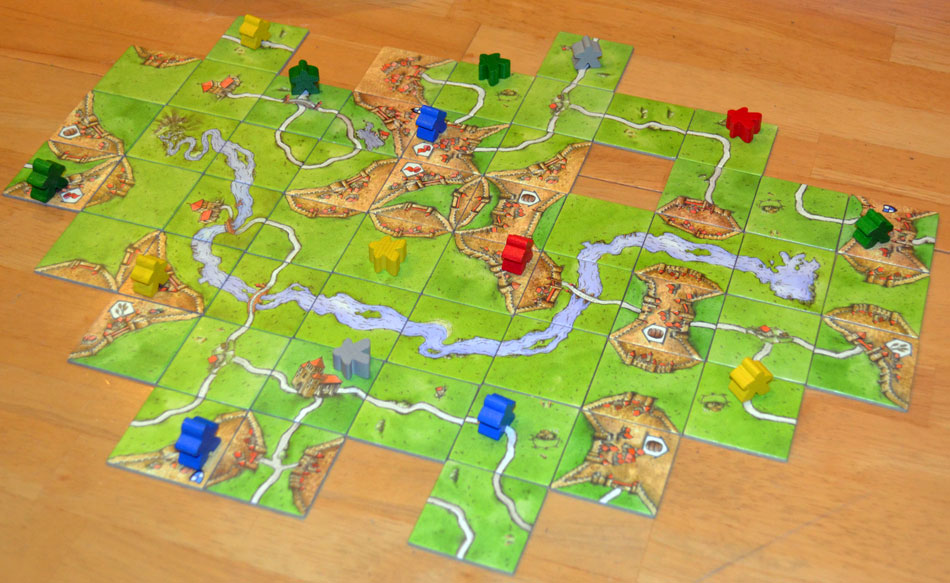
Carcassonne slipped through my fingers like sand through the hands of a toddler. I had totally forgotten about this lovely and simple Eurogame (Eurogames or German Games are games that focus more on strategy and resource management to get victory points, and not Player v Player conflict). A soul brother to Catan, although even simpler (if that is possible).

In each turn in Carcassonne, you play a tile, and have the possibility to play a person marker (the ever iconic Meeple). Depending on where you play the Meeple, it might become a farmer (in a field), a highwayman (in a road), a knight (in a city), a monk (in a monastery), etc. The game comes into its own because every played tile needs to connect fully with a previous one (roads can't start and end in the ether, cities must be closed by walls, etc).

You only have half a dozen meeples and although you can claim them back once you score an area (city, road.... you get the idea), you are at the mercy of the tiles. If you need to finish a city with a city tile, with a diagonal city wall running from upper left to lower right.... You might be in a lot of trouble, as your meeple knight is now stuck there, in a place where it will still score some point at game's end, but a fraction of what it would if you actually finished the city. There are by now about a dozen expansions with new tiles and new types of meeples, that keep adding to the story. You can still have a lot of fun with the base box though!

Rui's conclusion: Fast, engaging, simple and fun. A good warm-up game, or one for newbies. A hit, and rightly so!

Thursday, 29 January 2015

Marrakesh

'I have maaaaany carpets!'

Type: Strategy / Board
Players: 2 to 4
Time to explain to others: About 1 min
Time to play: About 20 minutes
Difficulty: To play 1/10, Game difficulty 4/10
Portability: Medium, some tokens
Overall: 8/10

In the soukhs of Marrakesh, the word comes trough the dusty narrow alleyways: a new caravan is arriving, loaded with gold from the south, silver from the east and metals from the north. They want but one thing, the thing north Africa is famous for above all else.

Carpets.

Ahead of the caravan, they send an agent, that will select the best carpets and give the exclusive rights to trade to the best seller. So the different artisans have but moments to make sure theirs are the best and most visible carpets!

Marrakesh is a lovely simple game I found quite by accident. It breaks down to two simple actions: a) roll a die, move the 'agent' that number of places, and b) lay down a carpet (lovely rectangular pieces of felt) touching the agents' place.

You can (and should!) cover opponents' carpets (to make sure yours are the most visible ones), and if the agent ends up in an opponents' carpet on your movement turn (depends on the dice, remember?), you need to pay that opponent an amount of gold proportional to the area occupied by that opponents' carpets.

When the last carpet is put down, all gold is counted, and every bit of exposed carped of a colour wins 1 extra gold. Whoever has more gold, is the winner!

This is a simple, fun, quick and engaging game. It plays fast, you delight in covering your opponents' work, and a bad decision might cost you the game.

Rui's conclusion: A highly thematic, quick and very simple game.  Highly recommended to young'uns and newbies. Perfect dinner party or games night game!

Tuesday, 27 January 2015

Castle Panic

'There might come a day where we don't crush Orcs, BUT IT IS NOT THIS DAY!'

Type: Strategy / Board
Players: 2 to 4
Time to explain to others: About 5 min
Time to play: About 30 minutes, possibly bit more
Difficulty: To play 3/10, Game difficulty 6/10
Portability: Medium (Loads of cards) and tokens
Overall: 9/10

Once upon a time, there was a mighty castle in a clearing, in the middle of a forest. Then one day, a horde of rampaging Orcs, Trolls and Goblins burst out of the undergrowth and attacked! (The reasons behind their grievances were not registered. Possibly a political disagreement, mayhap a border dispute). There's scores of them, and they are very angry.

And here the game begins. You assemble a little castle (6 towers, surrounded by 6 bits of wall) in the middle, and then, each turn, you take a number of triangular pieces from a bag, to represent our nasties jumping out of the forest. Each turn, more nasties spawn, the already in play ones advance one level towards the castle.... And then you have to kill them. 

You have a number of cards in your hand, of three types: Swordsman (hits in circle closest to castle), Knights (hits 2nd circle out) and Archers (hits furthest circle). Each of these types has 3 colours, representing the three arcs on the clearing, Blue, Green and Red. So to hit a hostile say, in the second circle out, on the blue third of the circle, you'd need a Blue Knight. 
Most of your enemies will need more than one hit to die. 

At this point, I hear you cry at the screen: 'But Rui! It's too much! 3 arcs and 3 circles, that's 9 sectors! Statistically there is no way you can have THAT ONE card you needIT CAN'T BE DONE!' But wait! All is not lost! Castle Panic is a cooperative game through and through, if you don't have the card you need to kill the closest enemy, you can trade cards with another player. 'Does anyone have a Green Knight or Swordsman??? Now-ish would be good!!!' 

(I heard recently that the game's difficulty drops dramatically if you play with 4 players, as someone is bound to have THAT card you need. I've never played with more than 3, but I would recommend drawing less cards, or only drawing on alternate turns)

Some nasties randomly spawned will be specials (tougher to kill, different powers to other nasties), but some of your cards will also be more powerful. If you kill them all and there is ANY part of the castle still standing you win, Otherwise....

Rui's conclusion: The game is fast, funny and non stop fun. Really good strategy games for young'uns, people that like shouting at board pieces, or people that like to have inane amounts of fun for 30 minutes. Highly recommended.

Sunday, 25 January 2015

Lords of Waterdeep

Every alley has a knife, every palace a cup of poison.


Type: Strategy / Resource management / Board
Players: 1 to about 6
Time to explain to others: About 5 to 10 min
Time to play: About 30 minutes, possibly bit more
Difficulty: To play 3/10, Game difficulty 4/10
Portability: Very Low. Dozens of tokens.
Overall: 9/10

In one of the multitude worlds of the Dungeons and Dragons universes, there is a place. A city of gleaming temples and shady ale-houses. Of slimy alleyways and fetid harbours. Stretching from the sunny Field of Heroes to the murky labyrinthine corridors of the Undermountain.

The city is called Waterdeep.

Lords of Waterdeep is a resource management game. It might look a bit odd at first, but when boiled down to its core, it is actually fairly simple. You are one of the titular Lords of Waterdeep, vying for control of the city. To grow in power and influence (in our case, victory points) you need to complete missions, ranging from assassinations to helping other inhabitants, to fighting invaders, to exterminating pests, to breeding Owlbears (bears with the heads of owls, cuter than it sounds).

Being a son (or daughter) of the nobility, you will of course NOT get your hands dirty. Of course not, perish the thought! You will send your agents, to hire fighters and wizards, to then do the job for you.

This is how the game works. Each turn, you have a number of agents (about 5, as it can increase or decrease). In turns, you will send your agents to different areas of town (Ale-houses, The University, The Temple, etc), and in each place you will hire a number of people (represented by small coloured cubes).

Each mission will require a number of these cubes. When you have the corresponding numbers and colours, you can claim that mission (and its victory points).

The only problem is that, although there are a number of cards that actively impact your opponents (negatively), the main issue of the game is one of the locations on the board. Only one agent can be in any location at any one time. So it is really easy to block the opponents and make it as hard as possible to get those coloured cubes (either by accident or on purpose).

And this is pretty much it. Some other elements add the all important element of randomness, like the lord you play will have a bonus for some missions and not others, and The Builders Guild, that will introduce new and different buildings and locations in every game.

Rui's conclusion: Although heavier than other games, LoW is still simple enough to explain in a few minutes. The resource management is a new dynamic, but one that is straightforward. You don't need to waste too much time on the intricacies if you don't want, just collect the cubes you need! It will please both newbies and veterans. Highly recommended.

Friday, 23 January 2015

Qwirkle

'If only I had a green star... I NEED A GREEN STAR!'


Type: Strategy / Pieces
Players: 2 to 4
Time to explain to others: 1 minute
Time to play: About 20 minutes
Difficulty: To play 1/10, Game difficulty 4/10
Portability: High (it comes with a travel bag (!))
Overall: 9/10

I hadn't yet covered the family of games to which Qwirkle belongs to (because to be honest, I don't own many), the abstract games. For no good reason, I hasten to add, a lot of them are fine and lovely games, and the absence of a narrative universe might even invite proper newbies into the game.

Case and point: my parents. My parents are not huge fans of board games, but they loved Qwirkle. It plays strategic and fast, you end up blocking other players by accident, more than by design, and it it simple and logical.

You have 5 pieces at any time. You play them so that you make a line. That line can be a) a line of same shape in all 6 different colours, or b) All 6 different shapes of the same colour. You cannot repeat either colour or shape in the same line (respectively). You win points for the longest line your piece made. When you make a 6-strong line (a Qwirkle), you get 6 points + 6 bonus.

And this is pretty much it, simplicity being its middle name, if it had one. 

Rui's conclusion: The abstract aspect of it is enticing, you can just relax and just follow the shapes and colours. Really good entry game for young'uns and newbies. A good family game, where everyone could get involved.

Thursday, 22 January 2015

King of Tokyo

'Run! Save yourselves! It's coming this way!' 'Grrraaaargh!'

Type: Board / Strategy / Combat / Dice
Players: 1 to about 4
Time to explain to others: 15 minutes
Time to play: About 20 minutes
Difficulty: To play 3/10, Game difficulty 4/10
Portability: Medium (some small tokes but not many)
Overall: 9/10

The scene: The Rising Sun capital 
The extras: The unfortunate inhabitants. 
The players: A succession of Daikaiju's (Big monsters) battling it out to see which one can become the titular King Of Tokyo.

The game is fairly simple: you control a giant monster and your opponents do the same. Your monsters (The usual, giant iguanas, giant apes, small bunnies in Mecha suits, cyber dragons, same old, same old....) battle it out, to try and reach 20 victory points as fast as possible.

Only one monster can be in the centre of Tokyo at any given time. Here, you earn more victory points per turn, but you don't regenerate. Also, you just became the bullseye for all other monsters. So you need to balance victory points and health.

Also, your regeneration and attacks are dice based, introducing a huge ammount of randomness to the proceedings. You can also gain energy cubes via the dice, with which you can buy enhancement cards and become more powerful, etc.

Rui's conclusion: A good, fast, fun game. Another good party one, but some guidance to newbies will be needed.

Wednesday, 21 January 2015

Magic, the Gathering

What colour will YOU be?

Type: Strategy / Card
Players: 2
Time to explain to others: 5 to 10 minutes
Time to play: About 20-30 minutes
Difficulty: To play 4/10, Game difficulty 5/10
Portability: High
Overall: 10/10

As hinted at on my last post, here we go.

*deep breath*

Amongst the multitude dimensions, there is a place. In the centre of a storm-battered plain, rolling purple-grey clouds above, there is a huge, dark, dusty temple dedicated to all card games that didn't work. There are dozens, perhaps hundreds of niches, each one with the skeletal mummies of games past. A place filled with brilliant but over complicated, or too simple, or badly drawn card games. Or good ones that simply could not reach up to the Leviathan.

I'm talking about Magic The Gathering.

Starting in the mid 90's, this game has managed to live, expand, evolve, and leave all others behind it. And it did all of this in just one way: Simplicity

The first time you pick up a Magic deck, you might feel a bit daunted, but don't! Starter decks are still published CONTINUOUSLY (like they have over the last 20 years). And inside most of them, there are simple rules for you to start playing. (that failing, their website has the same quick intro)

You and your opponent are wizards, fighting each other. Your decks have 3 types of cards, Creatures, Lands and Spells. Creatures fight other creatures (or failing that, the opposing wizard), lands give the resources to 'build' creatures or spells, and spells give the game a measure of unpredictability, boosting or killing creatures, injuring the wizard, defending creatures, etc.

Each card has a text box, filled with instructions. Some of the keywords might take a couple of games to get used to, but even the rookiest of players can start being decent at magic in a couple of games. And seeing your opponent play a card you've never seen, is an excuse to engage in conversation: 'What card is that? What does it do? Can I have a closer look?'

There are 5 factions in Magic (green, white, red, blue and black), each with radically different playing techniques. Finding the one you like is half the fun. And most decks have more than one colour (for balance and optimization), which then create issues with the type and number of lands....

Reams of paper and Terabytes of information are available out there on Magic tactics and deckbuilding. Some might complain about Magic's incessant expansion and how you continuously need to buy new decks and new boosters. All I will say is this: as I only play Magic informally, my investment to date has been modest. 

Rui's conclusion: The game is wonderful, flows fast and is really exciting. If you have 30 minutes to spare, you can do no worse.

Tuesday, 20 January 2015

Boss Monster


Type: Strategy / Card
Players: 2
Time to explain to others: 2 minutes 
Time to play: About 20 minutes
Difficulty: To play 2/10, Game difficulty 5/10
Portability: High
Overall: 9/10

Boss Monster is the first card game I'm covering, as I draw a deep long breath before I cover the Leviathan that is the card game to end all card games, I mean of course....

But I digress, that is talk for another time.

Boss Monster is a fun and fast cardgame, originally funded by Kickstarter, the haven of everything that is kitch, retro and 80's. Instead of being a hero fighting its way into a dungeon, you are the boss monster at the end, building you neat little dungeon, to try and obliterate any incoming heroes.

Keeping with the 80s look, the cards are pixelated, and the dungeon works linearly, from left to right, like on a 2D scrolling arcade or early ZX Spectrum or really early PC game. There are a handful of rules, that can be explained in a few minutes, and then its Hi-oh, hi-oh, to build our dungeon we go.

Rui's conclusion: Fast, easy and visually compelling. The retro look will attract the 1980-early 90s generation, as well as the more curious kids. Ultimately, really entertaining!