Monday, 16 March 2015

Zombie Dice

'Braaaaaaaaaaaaaainssssssss.......'

Type: Strategy / Dice
Players: 2 to whatever (Elimination based)
Time to explain to others: About 1 min
Time to play: About 15 minutes, possibly bit more
Difficulty: To play 1/10, Game difficulty 3/10
Portability: High. Just a set of dice.
Overall: 10/10

You are a hungry zombie, in what looks like is a fairly busy part of the world. Some of your victims are, well.... victims, but others have fairly big shotguns. It is up to you to decide how many victims to attack, but watch out! The first zombie to get to 13 brains wins!

This game is as fun as it is simple. To dictate what your zombie does, and out of 13 dice, you randomly select 3 and roll them. You can get one of three outcomes, a blast (you were shotgunned), some footprints (the victim escaped) and a brain (Mmmmmm.... braaaainsss......). You hold on to shots and brains and reroll the feet, adding new dice if you need to always roll 3.

If you get to 13 brains you win! However, if you collect 3 shots in a turn, you're knocked out, losing all brains you collected on that turn.The game quickly becomes a race against time, with zombies pulling back, when they accumulate 2 shots (they reset at the end of turn), and pushing forward again and again, trying for those yummy brains.

Rui's Conclusion: Fast, entertaining and endlessly fun. A good warm up game, fun for all ages and abilities. A must-have! 

Wednesday, 11 February 2015

Fluxx

'Draw one, play one, draw one play one, draw five play three, draw three play two... Wait, what??'

Type: Strategy / Card
Players: 2 to about 5
Time to explain to others: About 1 min
Time to play: About 30 minutes, possibly bit more
Difficulty: To play 3/10, Game difficulty 4/10
Portability: High. Just a deck.
Overall: 10/10

Fluxx is the card game equivalent of watching 1980s british comedy. It is amazing, you laugh your head off, it's great fun, and the recipie could not be simpler.

Your deck has a bunch of cards. Actions, that perform actions, Keepers that you.... Well, keep. And goals, that you have to.... Reach.

The designers went out of their way to make a game that was as physically instinctive, non-threatening and reachable to newcomers as you can possibly make it. The cards are colourful and simple, they are colour coded, and there's only three different types.

And then the carnage starts.

The main rule is 'Draw one card, Play one card'. There are however many cards in the gamer that change this, making you draw more (yay!) and/or play more (boo!).

Also, the Goal can change at any time. So you finally have the missing Keeper to end the game (by completing the Goal), but the opponent changes it. Lovely. Oh! And the Goal you had in your hand, sorry but now you have to Play all your hand, so you now changed the Goal on the table!

There are a number of themed variations of Fluxx (Monthy Python, Zombies, Sci Fi, etc), all great fun, and with the same dynamics.

To have a strategy in Fluxx is to court madness. The game is literally evolving and changing before your eyes. This just makes it more fun than I could possibly describe!

Rui's conclusion: Simple, newbie friendly and great fun. A perfect party or after dinner game. A must in whatever of its variations!

Sunday, 8 February 2015

Carcassonne


'Where the hells is this road going to go....?'
Type: Strategy / Board
Players: 2 to about 5
Time to explain to others: About 1 to 3 min
Time to play: About 30 minutes, possibly bit more
Difficulty: To play 3/10, Game difficulty 4/10
Portability: Medium. Loads of board tiles
Overall: 9/10

Carcassonne slipped through my fingers like sand through the hands of a toddler. I had totally forgotten about this lovely and simple Eurogame (Eurogames or German Games are games that focus more on strategy and resource management to get victory points, and not Player v Player conflict). A soul brother to Catan, although even simpler (if that is possible).

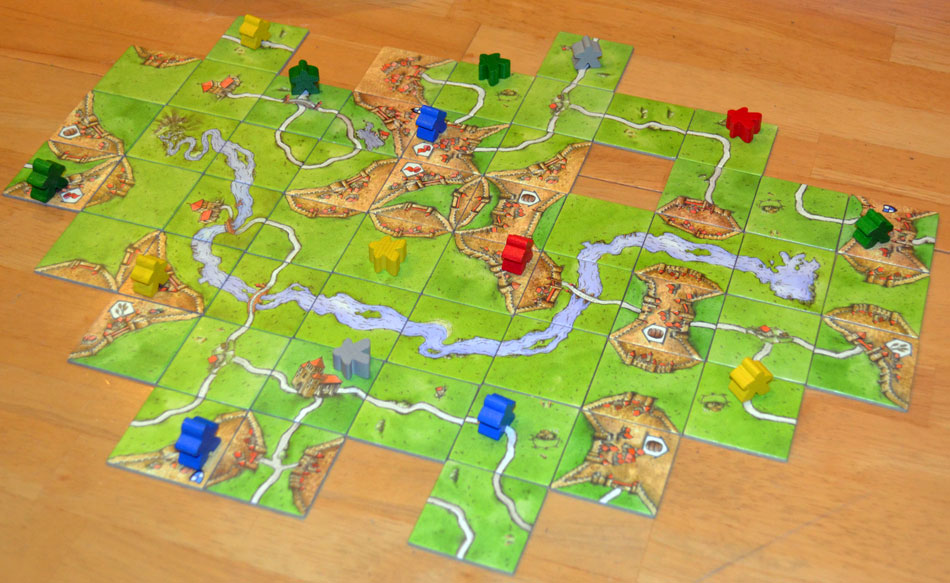
In each turn in Carcassonne, you play a tile, and have the possibility to play a person marker (the ever iconic Meeple). Depending on where you play the Meeple, it might become a farmer (in a field), a highwayman (in a road), a knight (in a city), a monk (in a monastery), etc. The game comes into its own because every played tile needs to connect fully with a previous one (roads can't start and end in the ether, cities must be closed by walls, etc).

You only have half a dozen meeples and although you can claim them back once you score an area (city, road.... you get the idea), you are at the mercy of the tiles. If you need to finish a city with a city tile, with a diagonal city wall running from upper left to lower right.... You might be in a lot of trouble, as your meeple knight is now stuck there, in a place where it will still score some point at game's end, but a fraction of what it would if you actually finished the city. There are by now about a dozen expansions with new tiles and new types of meeples, that keep adding to the story. You can still have a lot of fun with the base box though!

Rui's conclusion: Fast, engaging, simple and fun. A good warm-up game, or one for newbies. A hit, and rightly so!

Friday, 6 February 2015

Tikal

'The shaft of light! It's beaming onto the idol's hand! 
THAT'S where the switch to open the secret door is!'

Type: Strategy / Board/ Resource management (ish)
Players: 1 to 4
Time to explain to others: About 10 min
Time to play: About 45 minutes
Difficulty: To play 4/10, Game difficulty 6/10
Portability:Low, many tokens and board pieces
Overall: 8/10

Who has never wondered what it would be like, to wonder the jungles of South America, compass on one hand, machete on the other? To wonder into plazas where no man has walked for a millennium? To find the sacred Mayan plinths, dusty brown with the blood of a thousand slaves?

I came across this game as I was looking at the Spiel des Jahres winners (it won in 1999). These are the Oscars of the gaming world, and the winners are always the best of the best (on this blog, Catan and Quirkle come to mind).

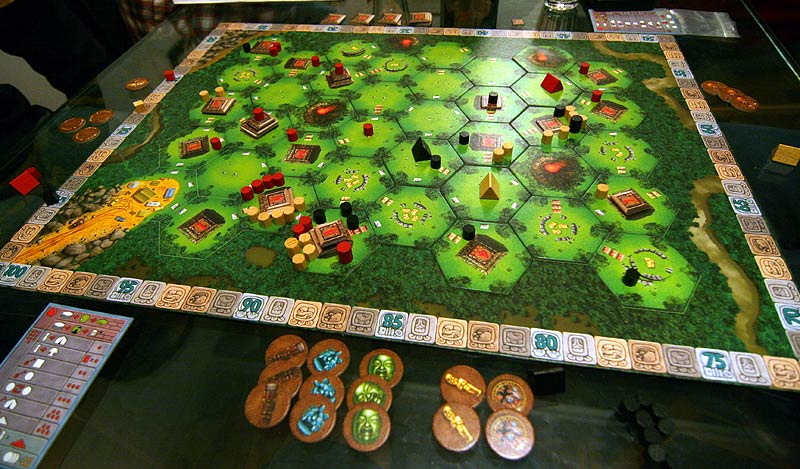
Tikal is a very thematic game, where you play opposing teams of archaeologists, striving to bring out more wonders and plunder out of the Mayan Tikal site (in Guatemala). At the beginning of each turn, each player has 10 action points to use as he/she sees fit. The number of options is fairly extensive, but you can move archaeologists already on site, you can call more onto the site, you can excavate more levels of sunken temples, dig out treasures and many many others.

A couple of innovative mechanics make this a much more strategic game that it might at first look like:

a) the board is built from tiles as you go along (so far, so good), but a number of markers on said tiles will dictate how many action points it takes for characters to move around. It might take 3 points to cross the board, but 8 to get to the one next door, where you actually want to be. (This is explained in game by arguing that there might be say, a hill or a small cliff between certain areas of the board)

b) 2 tiles have a volcano on them, and are therefore named, originally enough, the Volcano Tiles. They have no intrinsic value, they merely signify the start of a scoring round. You only add victory points at these two times. So you might be well behind, but if you throw caution to the wind, and focus on points points points at these times, you might move up quickly.

c) you gain control of a temple by having more people there than your opponent. Due to the capriciousness of movement (see a) ) this is better said than done.

The board is massive and towards the end game it has the tendency to slow down to a crawl. There are some pretty amazing online rules for mini-Tikal, playing on a smaller fraction of the board, and these work beautifully.

This post obviously simplifies the rules and the game. It plays very strategically, almost chess-like at times (not scoring now, but making a new camp, putting me in a much better position over next couple of turns, for example).

Rui's conclusion: Very atmospheric, and strategic. Not very fast, but one to play slowly and think about. Newbies will like it, with guidance. A good after meal game, if you like to fly in and steal the other teams' treasure!

Monday, 2 February 2015

Shadowrun Crossfire

'You don't know where the weapons are stored?...I think you'll find that was a shocking answer....'

Type: Strategy / Card / Deckbuilding
Players: 1 to 4
Time to explain to others: About 10 min
Time to play: About 90 minutes (mission dependent)
Difficulty: To play 4/10, Game difficulty 8/10
Portability: Medium to high, some cards
Overall: 8/10

Before I even begin this one, I need to admit my bias: I adore the Shadowrun universe. I played the card game, way back in the 90s, and I love every aspect of it.

In a nutshell, in the year 2012 (I know!...), magic returned to the World, in a big way. Some people realised they had magic powers, some mutated into elfs, dwarves, orks and trolls (they had the genes, but the lack of magic in the environment kept it latent).

It is now the 2060s, and we are left, after a lot of political and social upheaval, with the 6th World: A universe where elfs have cybernetic implants, orcs hack into the Matrix (a global 3-dimensional representation of the granddaughter of the internet), and dwarf street samurais kill you as fast as they hit you. In the knees. To start with. Its William Gibson's Neuromancer married with Tolkien. HOW CAN YOU NOT LOVE IT!

Oh and the US president is a dragon. In human form. Did I mention that? I feel like I should.

Crossfire is the latest incarnation of Shadowrun. Like Battletech, this is a franchise full of potential, that somehow successive owners have struggled to pin down.

At its core, it is a deck building game. You have characters (Runners), and each runner has a job (Role). These are interchangeable during set up, although I like my runners to keep their roles (more on this later). Each role has a set of basic cards. As you defeat obstacles you earn money, and buy better/more useful cards. And so you 'enrich' your deck with better cards, as the difficulty increases, levelling up (hopefully!) your abilities as the baddies increase in power and number.

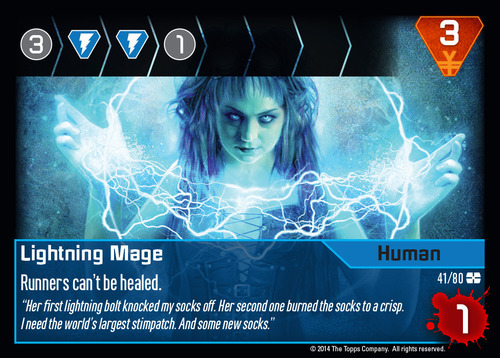
Obstacle cards have power numbers and colours in sequence at the top. Without being fastidious about the rules, all of the runners need to cooperate, to play cards to match numbers (play 3 cards of any colour), or colours (someone on their turn needs to play a blue Mage card). (See above image). When all the icons have been matched, the obstacle is defeated, and the runners score the credits.

It is a hard game, and you die more often than not. When one of your runners dies (it can happen like THAT!), if there is at least 1 other runner alive, it is like the team retreated. If all survive and all obstacles are defeated, it is a win! Experience points are attributed accordingly and may be spent on upgrades.

You are encouraged to play this game as a proper RPG. Upgrades cannot be changed back later on, you are - literally, as you are given stickers - stuck with them. I like to keep my team constant, same runners, same roles.

Rui's conclusion: Hard, strategic (with a touch of combat) and fun. If you're not a fan of the franchise, you will enjoy it, but might miss some nuances. If you want to explore a techno world with cyborgs, dragons, fire spirits and big guns, this is your stop. All change please!

Thursday, 29 January 2015

Marrakesh

'I have maaaaany carpets!'

Type: Strategy / Board
Players: 2 to 4
Time to explain to others: About 1 min
Time to play: About 20 minutes
Difficulty: To play 1/10, Game difficulty 4/10
Portability: Medium, some tokens
Overall: 8/10

In the soukhs of Marrakesh, the word comes trough the dusty narrow alleyways: a new caravan is arriving, loaded with gold from the south, silver from the east and metals from the north. They want but one thing, the thing north Africa is famous for above all else.

Carpets.

Ahead of the caravan, they send an agent, that will select the best carpets and give the exclusive rights to trade to the best seller. So the different artisans have but moments to make sure theirs are the best and most visible carpets!

Marrakesh is a lovely simple game I found quite by accident. It breaks down to two simple actions: a) roll a die, move the 'agent' that number of places, and b) lay down a carpet (lovely rectangular pieces of felt) touching the agents' place.

You can (and should!) cover opponents' carpets (to make sure yours are the most visible ones), and if the agent ends up in an opponents' carpet on your movement turn (depends on the dice, remember?), you need to pay that opponent an amount of gold proportional to the area occupied by that opponents' carpets.

When the last carpet is put down, all gold is counted, and every bit of exposed carped of a colour wins 1 extra gold. Whoever has more gold, is the winner!

This is a simple, fun, quick and engaging game. It plays fast, you delight in covering your opponents' work, and a bad decision might cost you the game.

Rui's conclusion: A highly thematic, quick and very simple game.  Highly recommended to young'uns and newbies. Perfect dinner party or games night game!

Tuesday, 27 January 2015

Castle Panic

'There might come a day where we don't crush Orcs, BUT IT IS NOT THIS DAY!'

Type: Strategy / Board
Players: 2 to 4
Time to explain to others: About 5 min
Time to play: About 30 minutes, possibly bit more
Difficulty: To play 3/10, Game difficulty 6/10
Portability: Medium (Loads of cards) and tokens
Overall: 9/10

Once upon a time, there was a mighty castle in a clearing, in the middle of a forest. Then one day, a horde of rampaging Orcs, Trolls and Goblins burst out of the undergrowth and attacked! (The reasons behind their grievances were not registered. Possibly a political disagreement, mayhap a border dispute). There's scores of them, and they are very angry.

And here the game begins. You assemble a little castle (6 towers, surrounded by 6 bits of wall) in the middle, and then, each turn, you take a number of triangular pieces from a bag, to represent our nasties jumping out of the forest. Each turn, more nasties spawn, the already in play ones advance one level towards the castle.... And then you have to kill them. 

You have a number of cards in your hand, of three types: Swordsman (hits in circle closest to castle), Knights (hits 2nd circle out) and Archers (hits furthest circle). Each of these types has 3 colours, representing the three arcs on the clearing, Blue, Green and Red. So to hit a hostile say, in the second circle out, on the blue third of the circle, you'd need a Blue Knight. 
Most of your enemies will need more than one hit to die. 

At this point, I hear you cry at the screen: 'But Rui! It's too much! 3 arcs and 3 circles, that's 9 sectors! Statistically there is no way you can have THAT ONE card you needIT CAN'T BE DONE!' But wait! All is not lost! Castle Panic is a cooperative game through and through, if you don't have the card you need to kill the closest enemy, you can trade cards with another player. 'Does anyone have a Green Knight or Swordsman??? Now-ish would be good!!!' 

(I heard recently that the game's difficulty drops dramatically if you play with 4 players, as someone is bound to have THAT card you need. I've never played with more than 3, but I would recommend drawing less cards, or only drawing on alternate turns)

Some nasties randomly spawned will be specials (tougher to kill, different powers to other nasties), but some of your cards will also be more powerful. If you kill them all and there is ANY part of the castle still standing you win, Otherwise....

Rui's conclusion: The game is fast, funny and non stop fun. Really good strategy games for young'uns, people that like shouting at board pieces, or people that like to have inane amounts of fun for 30 minutes. Highly recommended.